For years, marketers have debated the merits of event lead capture versus webinar leads. One side championed the high cost and high intent of in-person handshakes. The other praised the scale and efficiency of digital events. It felt like a binary choice: spend your budget on airfare and booth carpet or on a slick virtual event platform.
That debate’s over. It's the wrong way to think about growth.
We shouldn't ask which channel performs "better." Instead, let’s ask: How do you build a single, unified revenue engine where your best digital leads and your best in-person leads work together to accelerate deals? Pitting them against each other is like asking if your engine needs pistons or fuel. You need both, working in sync.
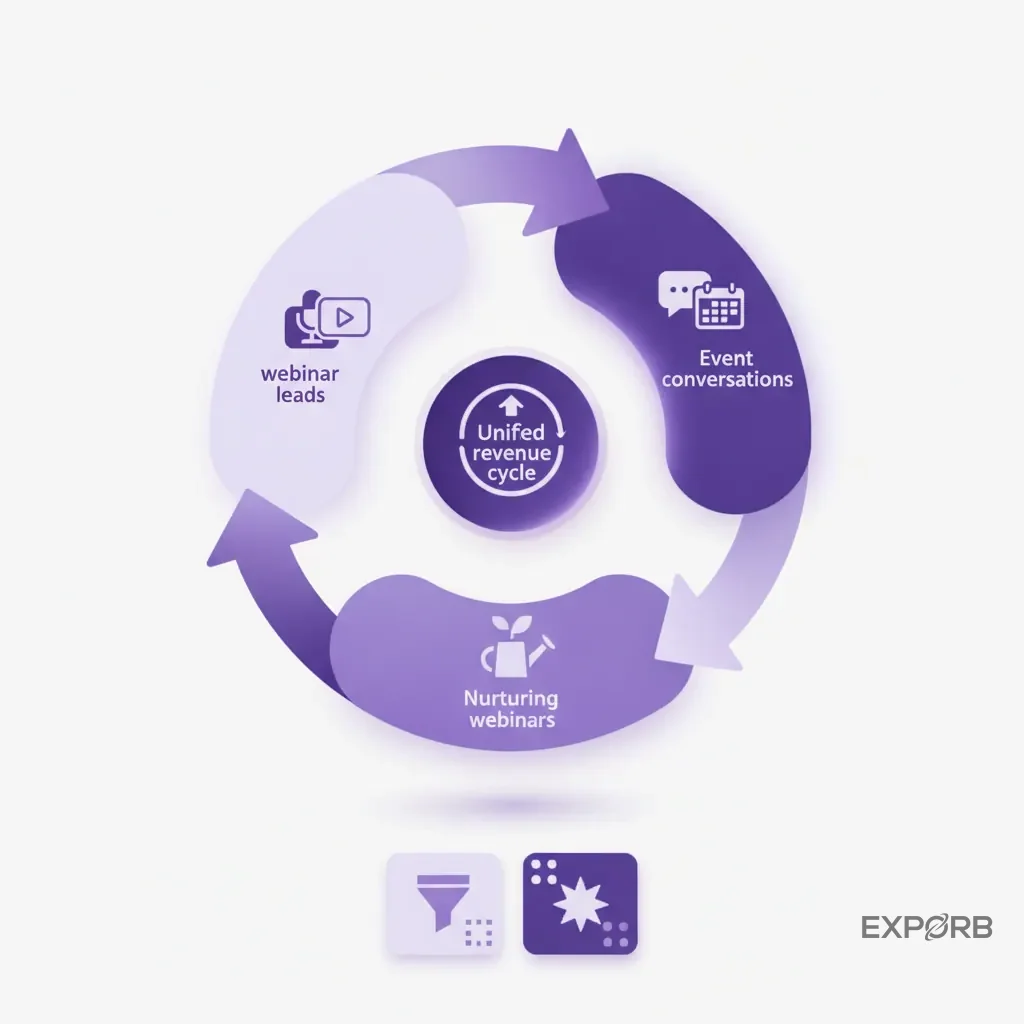
Why the old debate's officially over
The old model siloed teams. Your event team went to Vegas, came back with a fishbowl full of business cards, and spent a week manually entering data. Meanwhile, your demand gen team ran a webinar, got 500 sign-ups, and pushed them into a generic email nurture. The two teams barely spoke, and they never shared their data.
This self-inflicted wound on your pipeline is massive. Your best prospects attend both. They see your webinar, then they want to talk to your expert at a trade show. Or they meet your team at an event, then sign up for a deep-dive webinar. When your lead capture strategy treats these as separate worlds, you lose all that context. You end up with a fragmented view of the buyer's journey—and your follow-up feels generic and disconnected.
Introducing the unified B2B revenue engine
The modern playbook treats events and webinars as two sides of the same coin. They aren't competitors for budget; they're complementary stages in a relationship.
- Webinars are for scale. They educate the market, generate broad interest, identify prospects with initial intent, and fill your funnel. They're your top-of-funnel powerhouse.
- Events are for depth. They convert high-intent prospects, build trust with buying committees, uncover nuanced pain points, and close complex deals. They're your mid- and bottom-of-funnel accelerator.
When you connect them, incredible things happen. You use webinar attendee lists to book priority meetings at your next trade show. You use the rich conversation data from the show floor to create hyper-relevant, post-event webinar content. It's a flywheel, not a set of parallel, non-intersecting lines.
What to do next for your 2026 strategy
- Stop the "vs." mindset. It's about integration, not choosing one over the other.
- Map the entire journey. Understand how a prospect might interact with a webinar before an event, and vice-versa.
- Unify your data. Your event lead data and your webinar engagement data need to live in the same system and inform each other. A badge scan from a trade show is far more valuable when you know that person also attended three of your technical webinars.
- Connect your channels. The rest of this article will show you how to build this unified engine, from the data that proves why it works to the specific plays you can run.
Why do 73% of leads go cold within 72 hours?
Let’s start with the most painful truth in lead generation, a number that should keep every marketer up at night. According to research cited by DigitalApplied, a staggering 73% of event leads go cold if you don't follow up within 72 hours. The first 24 hours are even more critical. Speed matters.
This isn't just an event problem; it's a fundamental human problem. And it affects your webinar leads just as much. Attention's fleeting. By Friday, a prospect genuinely excited about your solution on Tuesday will have moved on to five other priorities. Speed isn't a "nice to have." It's the single biggest predictor of whether a lead will convert or die.
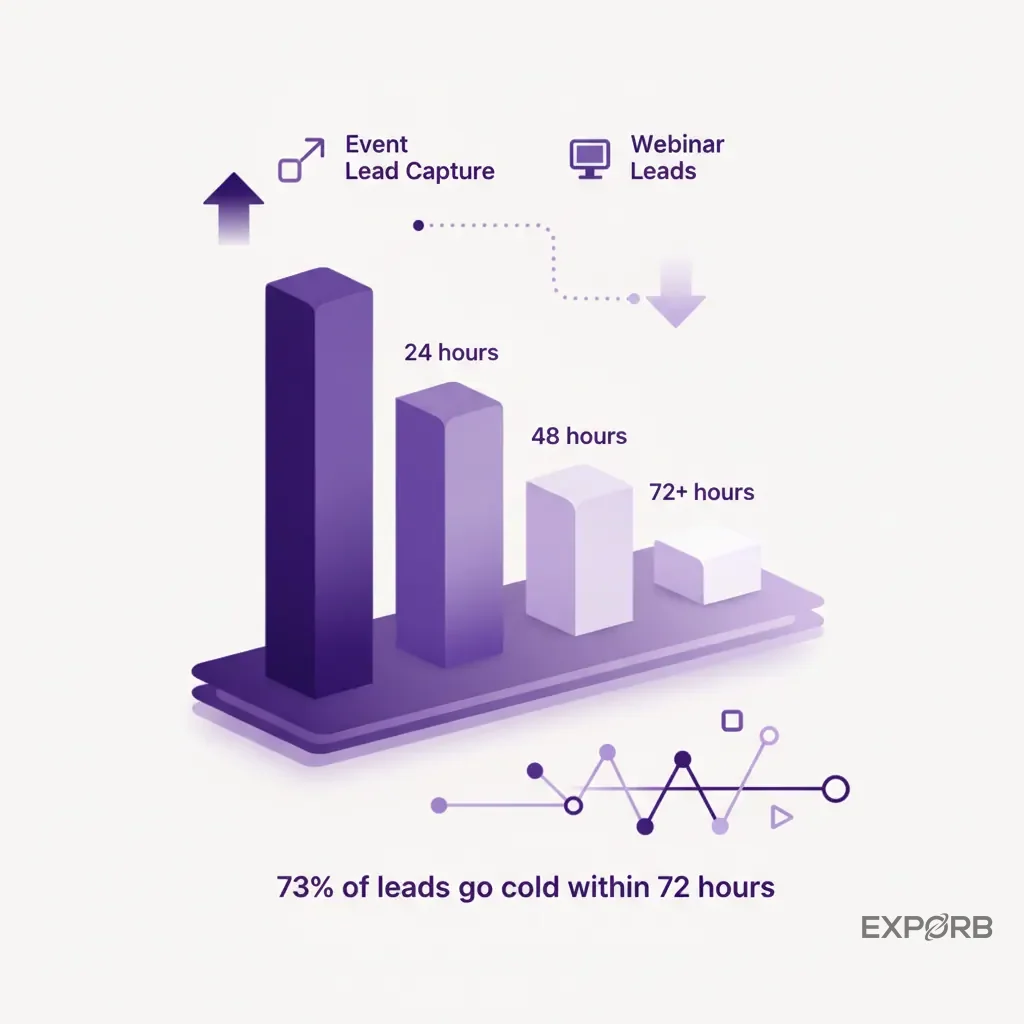
The critical follow-up window for both channels
Think about the last trade show you attended. You're energized, you have a great conversation with a vendor, and you hand over your card. You expect a follow-up email that afternoon or the next morning, referencing your specific conversation.
Now, what usually happens?
Silence. For a week. Then, you get a generic, "Thanks for stopping by our booth!" email that's clearly been sent to 500 other people. The context is gone. The urgency is gone. The opportunity is gone. You've forgotten what you talked about, and so have they.
The same decay happens with webinars. Someone attends your session, they're highly engaged, they ask a great question in the Q&A. That's a massive buying signal. The perfect time to follow up is within the hour, while their problem's still top of mind. But most sales teams wait days, lumping them into a standard sequence. By then, the moment's passed.
What traditional lead collection misses: Speed and context
The speed problem stems from the data collection method.
- At events: You get a pile of business cards, messy handwritten notes, and a spreadsheet of badge scans that takes days to clean up and import. Your team can't follow up because they don't have clean, actionable data until a week after the show.
- With webinars: You get a CSV export from your webinar platform. It gives you names, titles, and emails. Maybe you get some engagement data like "attended 45 minutes." But you don't get the why. What was their specific question? What part of the presentation resonated?
In both cases, you're losing the two most important things: speed and context. Without speed, you miss the window of interest. Without context, your follow-up is generic and ineffective. You can't send a personalized message if you don't remember what you talked about. That's why so many teams struggle with post-event follow-up—the data they capture is shallow and slow. Tools that offer AI-powered email follow-up directly from the event floor are designed to solve this exact problem, closing the gap between conversation and outreach.
Auditing your current speed-to-lead
How fast is your team right now? Be honest.
- For events: When does the first personalized (not bulk) follow-up email get sent to a top-tier lead after a conversation at your booth? Is it hours, or is it days?
- For webinars: When does a sales rep reach out to someone who asked a high-intent question during the Q&A? Is it immediate, or does it wait for the standard MQL sync?
If your answer for either is measured in days, you're leaving a massive amount of pipeline on the table. Fixing this speed-to-lead gap is the single highest-impact activity you can focus on to improve the ROI of both your event and webinar programs.
What makes webinar leads so efficient for scaling demand?
Webinars are the undisputed workhorse of B2B demand generation for a reason: they offer incredible scale and efficiency. While an event team might talk to 100 people over three days, a single webinar can engage 500 prospects in 60 minutes. According to WaveCNCT's 2026 report, 87% of businesses now use webinars, and 52% rank them among their top three performing channels.
The numbers don't lie.
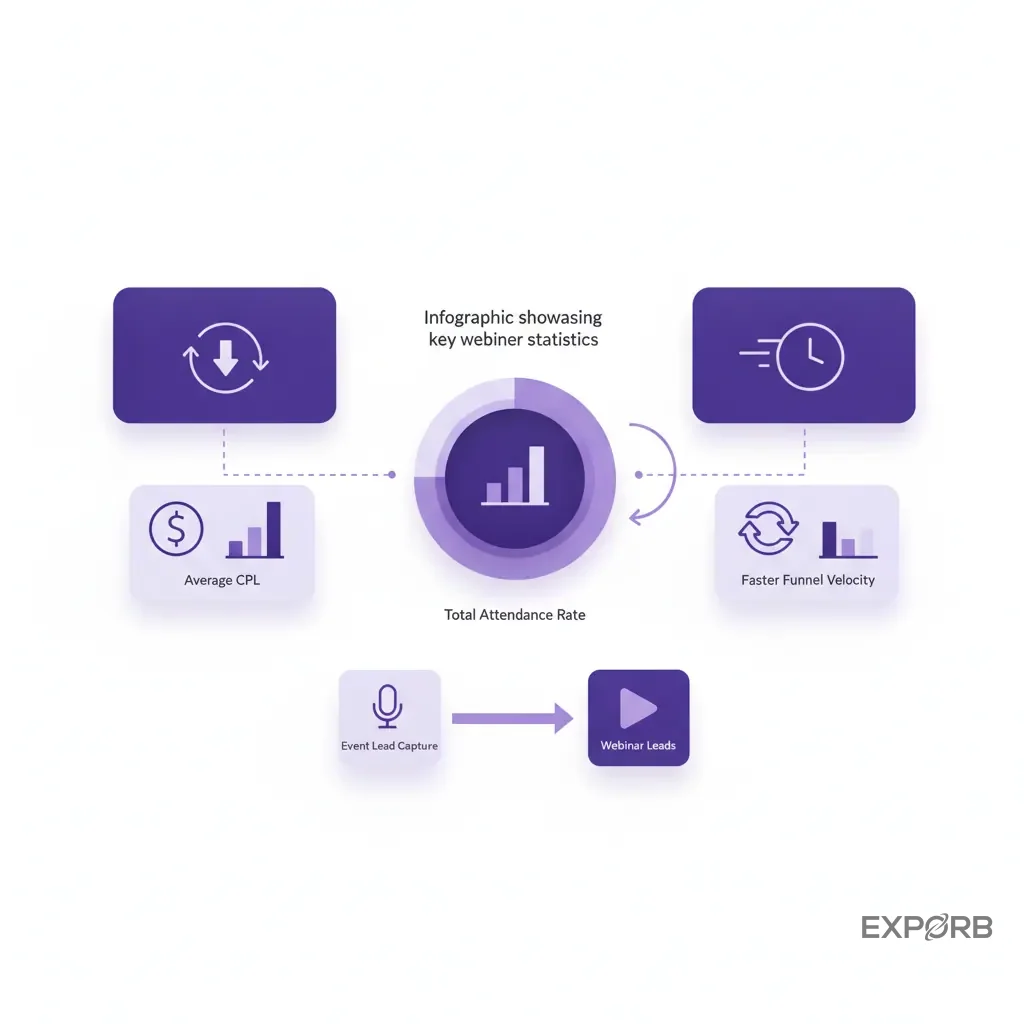
Unpacking the data: $72 cost-per-lead and faster sales cycles
Let's look at the benchmarks. The average cost per lead (CPL) for a webinar is around $72. Compare that to a trade show at $198 or a conference at a whopping $811. From a pure cost-efficiency standpoint, webinars are in a league of their own.
But it's not just about cost. It's about speed. The same WaveCNCT data shows that webinar-generated leads move through the sales funnel about 22% faster. Why? Because you're educating them at scale. You're answering their top questions and overcoming objections before they even speak to a salesperson. This pre-education shortens sales cycles significantly.
And the quality's there, too. A report from Martal Group found that 73% of B2B marketers say webinars produce their best-quality leads. This isn't just about quantity; it's about attracting an engaged, interested audience.
The power of digital engagement data for lead scoring
This is the secret weapon of webinar leads: the rich digital footprint they leave behind. You don't just get a name and an email. You get a detailed record of their engagement.
- Did they register but not attend? (Low intent)
- Did they attend for 10 minutes and drop off? (Medium intent)
- Did they stay for the entire 60-minute session? (High intent)
- Did they ask a question in the Q&A? (Very high intent)
- Did they click the call-to-action link at the end? (Hottest intent)
This data's gold for lead scoring and prioritization. Your sales team doesn't have to guess who to call first. They can focus their energy on the 47% of attendees who qualify as leads based on their actual behavior. This is a level of data precision that's nearly impossible to get from a simple badge scan at a trade show.
Limitations: Where webinar leads fall short
For all their strengths, webinars have clear limitations. They're primarily a one-to-many communication channel. You can't have a deep, two-way conversation with 300 people at once.
You miss out on:
- Nuanced Discovery
- Relationship Building
- Engaging Buying Committees
- Addressing Unique Business Problems
Webinars are fantastic for generating and qualifying leads at the top of the funnel. But when it's time to close a complex, high-value deal, you often need the high-touch, personal connection that only an in-person event can provide.
Related: The Ultimate Guide to Trade Show Lead Capture
Why are in-person event leads irreplaceable for closing complex deals?
If webinars are your air cover, in-person events are your special forces. They're more expensive and less scalable, but for certain objectives, they're truly essential. You don't spend $50,000 on a booth to generate 1,000 low-quality names. You do it to have 50 high-quality conversations that can change the trajectory of your quarter.
Most companies make a big mistake trying to measure Event ROI with the same CPL metric they use for webinars. It's apples and oranges. An event lead isn't just a name in a database; it's a relationship initiated.
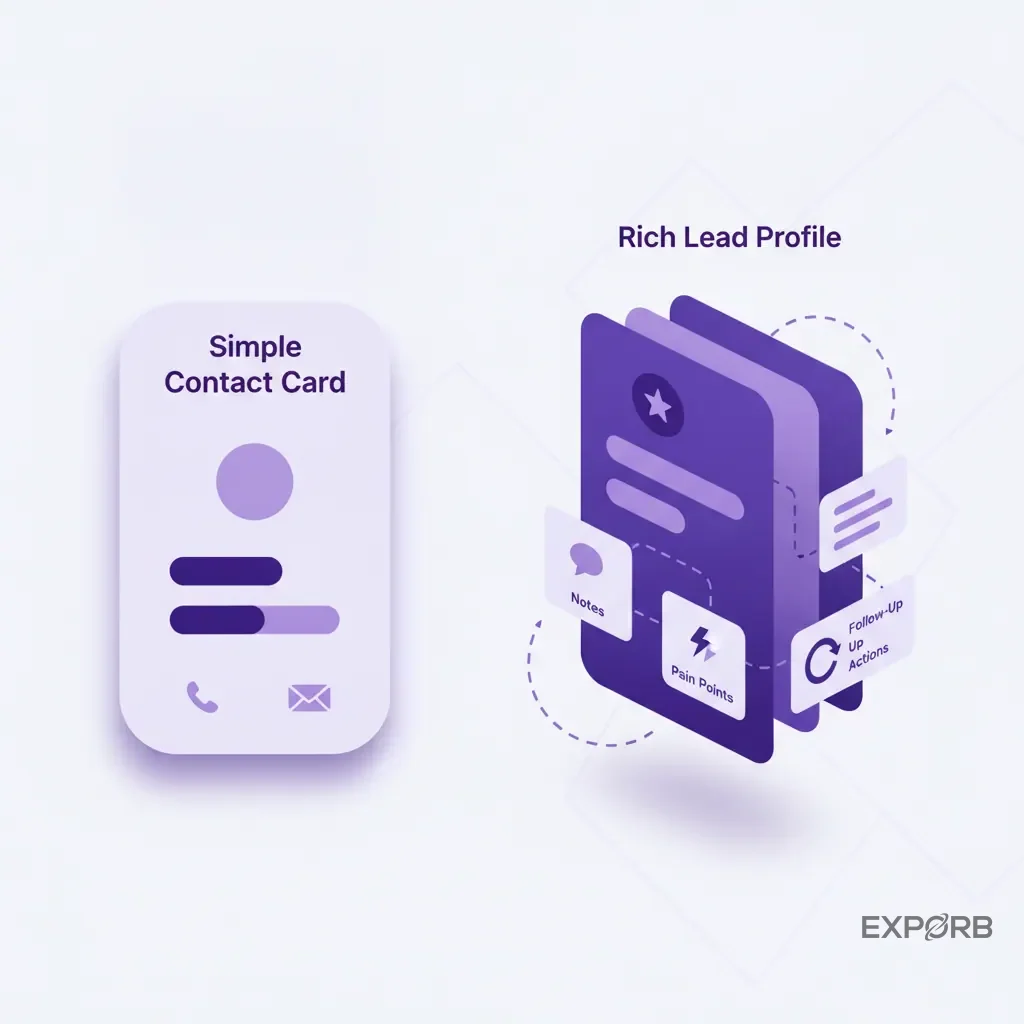
The high-intent signal of a trade show conversation
Think about the effort involved for a prospect to talk to you at a trade show. They had to get budget approval, book a flight and hotel, walk a massive convention center floor, find your booth, and choose to spend their limited time speaking with your team.
That's a massive signal of intent.
This person isn't just casually browsing. They have a problem, they believe you might be able to solve it, and they're actively investing their time and their company's money to find a solution. A ten-minute conversation with this person is often more valuable than 100 webinar attendees who clicked a link in a newsletter. The qualification's baked into their presence.
Building relationships and influencing buying committees
Complex B2B sales are rarely made by one person. They're made by a buying committee that can include an economic buyer, a technical buyer, a user buyer, and an influencer. It's incredibly difficult to get all these people on a single webinar.
But they all go to the big industry trade show.
Events are your single best opportunity to meet and influence the entire committee at once. Your CEO can talk to their CEO. Your lead engineer can talk to their head of IT. Your sales rep can connect all the dots. You can build consensus and trust across their organization in a way that's simply not possible through digital channels alone. This is where you build the relationships that get deals unstuck.
The hidden cost: Quantifying the true investment beyond CPL
Most companies are terrible at capturing the value of these conversations. They spend a fortune on the booth, the travel, and the sponsorships. But they spend $0 on a strategy and a tool to capture the rich, unstructured data from the conversations happening at the booth.
Your team has a fantastic 20-minute discussion, uncovers three critical pain points, and agrees on a next step. What happens to that information? It gets scribbled on the back of a business card, typed into a random phone note, or worse—it's forgotten entirely by the time the rep gets back to the hotel.
The lead eventually gets uploaded to the CRM as "John Doe - Acme Corp - Scanned at Booth #1234." All that valuable context is lost forever. This is the definition of a founder's blind spot. You're investing hundreds of thousands of dollars to generate these conversations, but you have zero visibility into what was actually said. You can't build a pipeline on "dead business cards." At Exporb, we see this pattern often. That's why having a dedicated trade show lead capture process is so critical—it protects your investment.
How do event and webinar leads compare across key business metrics?
So, how do you decide where to allocate your budget and effort? You need to look beyond surface-level metrics like CPL and compare these two channels across the factors that actually drive revenue: lead quality, pipeline velocity, deal size, and data richness.
They serve different purposes, and understanding their unique strengths and weaknesses is key to building a strategy that gets the best of both worlds.
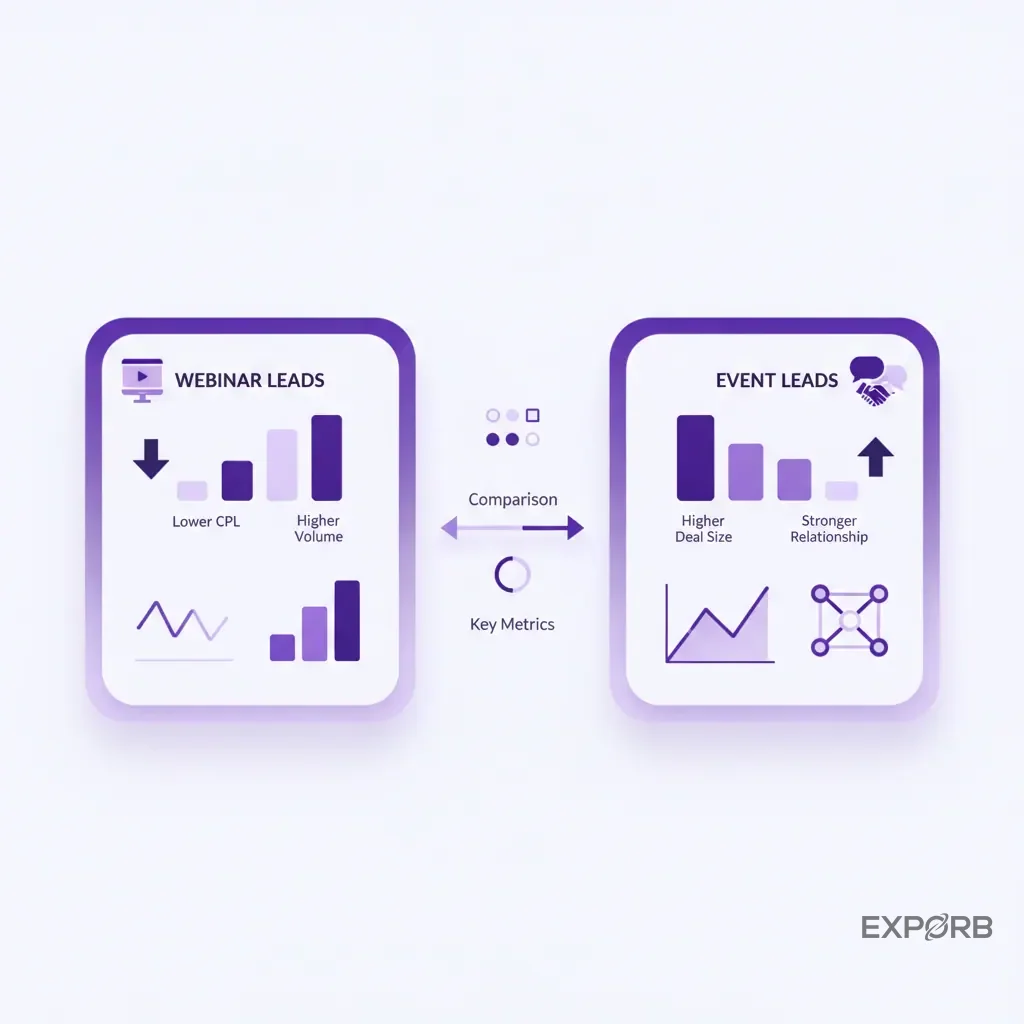
Lead quality vs. lead quantity: A data-driven breakdown
This is the classic trade-off.
- Webinars excel at quantity. It's not uncommon to get hundreds or even thousands of registrants for a single event. Average attendance is around 47-49%, according to data from Zoom. This makes them an unbeatable engine for filling the top of your funnel.
- Events excel at quality. The number of leads is much smaller, but the intent is far higher. Someone who seeks you out for a face-to-face conversation is, by definition, more qualified than someone who passively watched a presentation.
You need both. The high quantity from webinars feeds your nurture streams and identifies early interest. The high quality from events provides the sales-ready opportunities that your account executives can close quickly.
Comparing pipeline velocity and deal size influence
How do these leads move through the funnel and how big are the deals they create?
- Webinar leads move faster at the top of the funnel. As we saw earlier, they can shorten the initial sales cycle by 22% because they're pre-educated.
- Event leads accelerate deals at the bottom of the funnel. When you're trying to get a complex, six-figure deal over the finish line, a single in-person meeting with key stakeholders can do more than three months of emails and calls. Events are where you unblock stalled deals and get executive buy-in.
In terms of deal size, events often have a much stronger influence. The trust and relationships built face-to-face give you the ability to negotiate larger, more strategic partnerships. You're not just a vendor on a screen; you're a trusted partner they've met in person.
Data richness: Behavioral analytics vs. conversation intelligence
This is the most important distinction. Both channels generate data, but it's a completely different kind of data.
- Webinar data is quantitative and behavioral. You get clicks, viewing duration, poll answers, and CTA conversions. It's great for scoring at scale.
- Event data is qualitative and conversational. It's the specific pain points, the buying timeline, the key competitors mentioned, the internal politics of the deal. It's the "why" behind the "what."
The problem is that historically, 99% of this rich conversational data from events has been lost. It never makes it into the CRM. Modern event lead capture tools are changing this. By using voice notes and AI transcription, you can finally capture the actual content of the conversation and turn it into structured, actionable data.
Here's a direct comparison:
Comparison of Webinar Leads vs. In-Person Event Leads
The founder's blind spot: Why event lead capture is the missing link in your sales funnel
Here's a scenario I've seen play out a hundred times. A founder or VP of Sales spends $100,000 on a major industry trade show. They send their top four sales reps. The booth looks amazing. The reps are busy for three straight days, talking to hundreds of people.
They come back to the office, and the founder asks, "How'd it go? Did we get any good leads?"
The team dumps a bag of 200 business cards on the desk. "It was great! We were swamped."
The founder now has a pile of cardboard and zero insight. Which of these 200 people are hot leads? Which are competitors? Which are just students looking for swag? What did you talk about with that VP from your dream target account? What are their pain points? What are the next steps?
The answer's usually a shrug. "I think I wrote some notes on the back of that one..."
This is the founder's blind spot. You're investing more in events than almost any other marketing channel, yet you have the least visibility into the results. It's a black box. This is precisely why we built Exporb.
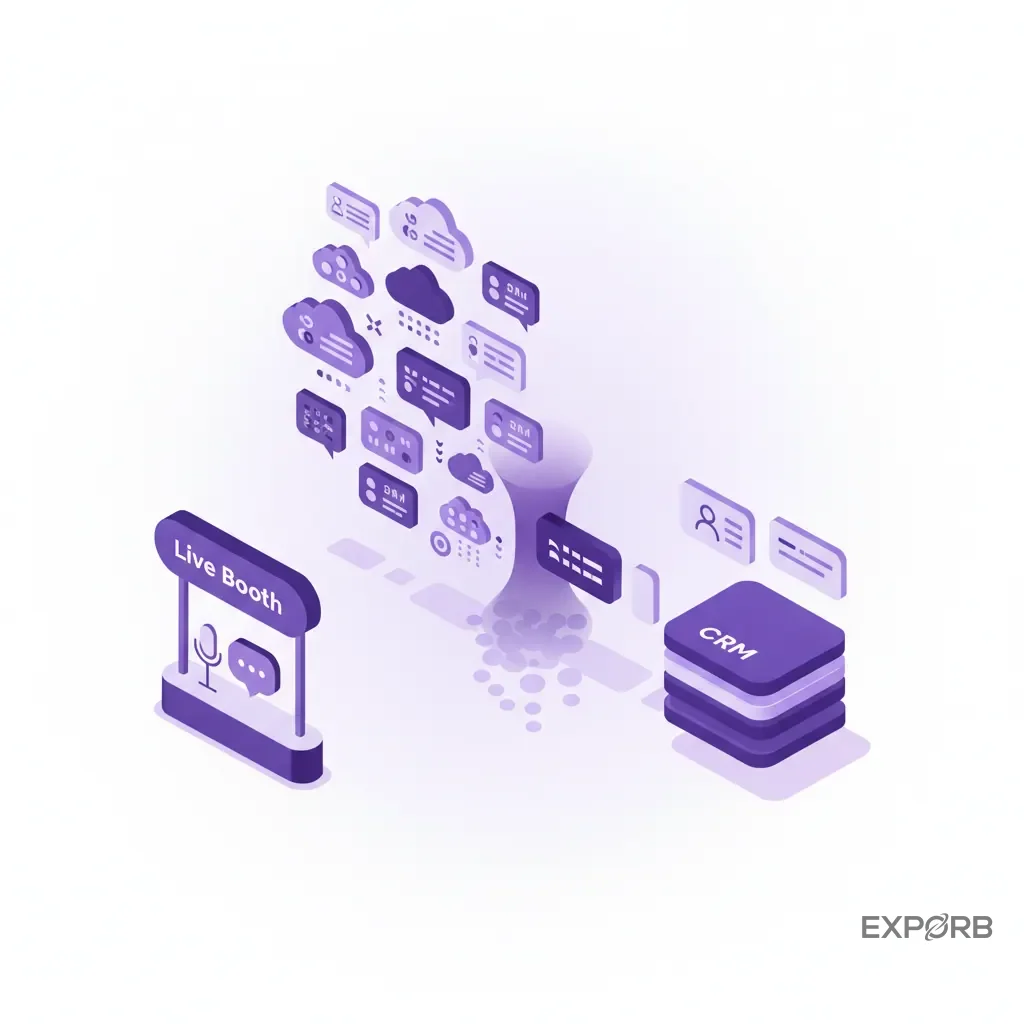
Misconception: A great booth doesn't capture great conversations
You can have the most beautiful, expensive booth on the floor. You can have the best coffee, the coolest swag, the most engaging presentation. But if your system for capturing the outcome of the conversations is a pen and the back of a business card, you've failed.
The booth's job is to attract traffic. Your team's job is to have great conversations. Your lead capture system's job is to turn those conversations into structured, actionable data that can be used to generate pipeline.
Most companies nail the first two and completely ignore the third. They spend the money to create the opportunity but have no mechanism to capitalize on it. It's like building a world-class manufacturing plant and then having no trucks to ship the product.
Scenario: What your team learned vs. what ends up in the CRM
Let's break down the data loss.
What your rep learns in a 10-minute conversation:
- The prospect's company's struggling with legacy system X.
- They have a budget of $250k approved for a solution in Q3.
- The key decision maker's Sarah, the CTO, who wasn't at the show.
- They're currently evaluating your top two competitors.
- The agreed-upon next step's to send a technical whitepaper and schedule a demo with Sarah for next week.
What ends up in your CRM a week later:
- Contact: Bob Smith
- Company: Acme Inc.
- Lead Source: Trade Show 2026
- Notes: (empty)
All of that critical intelligence—the pain, the budget, the timeline, the decision-maker, the next step—is gone. It evaporated somewhere between the noisy show floor and the Monday morning data entry slog. The sales team can't do a proper follow-up because they don't have the information. Marketing can't score the lead properly. The entire investment in that conversation is wasted.
From a simple badge scan to structured conversation data with AI
Badge scanners don't solve this. They just digitize the business card. You get a name, title, and email faster, but you still miss the most important part: the context of the conversation.
This is where modern lead capture platforms make a difference. Instead of just scanning a badge or a card, your team can:
- Quickly scan a business card using AI-powered OCR.
- Record a quick voice note summarizing the conversation. "Bob from Acme needs to replace system X by Q3, budget's $250k, next step's demo with Sarah the CTO."
- Snap a photo of a whiteboard diagram or a specific product they were interested in.
Behind the scenes, AI transcribes the audio, analyzes the content, and populates fields in your CRM. The lead that shows up is no longer just a name. It's a rich profile with structured data on pain points, intent, and next steps. Your team can follow up in minutes, not weeks, with a perfectly personalized email. And you, the founder, finally have visibility into the actual ROI of your event spend.
How to build a unified lead engine that connects your channels
Okay, let's get practical. How do you stop treating events and webinars as separate activities and start building a single, cohesive revenue engine? It requires a shift in mindset and process, focusing on how each channel can set the other up for success.
It's a three-part playbook: pre-show, at-show, and post-show.
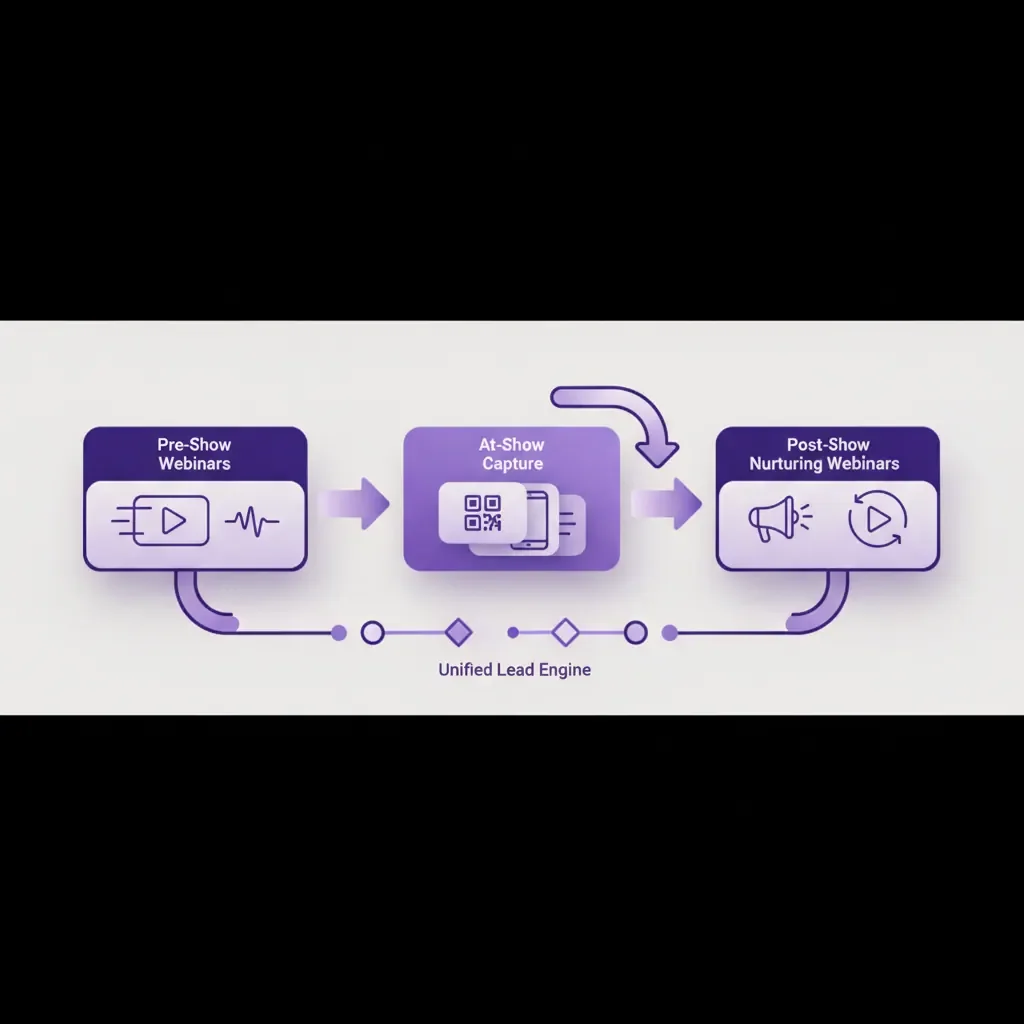
The pre-show playbook: Using webinars to warm up target accounts
Your event doesn't start when the doors to the exhibit hall open. It starts 4-6 weeks before.
- Identify Your Target Accounts: Which companies do you absolutely need to talk to at this event? Work with sales to build a target list.
- Run a "Pre-Show" Webinar: Host a webinar specifically for people attending the event, or on a topic highly relevant to the event's theme. Invite your target account list. The topic could be "Top 5 Trends to Watch at [Event Name]" or a deep dive into a problem you know your buyers will be discussing.
- Mine the Engagement Data: Look at who registered, who attended, and who asked questions. This is your priority list for the event. Your sales team should be proactively reaching out to these highly engaged, pre-warmed contacts to book meetings at your booth.
You're no longer showing up cold. You're arriving with a list of people who are already familiar with your brand and your expertise, and you have scheduled conversations on your calendar. This simple play can dramatically increase the quality of your booth traffic.
The at-show workflow: Capturing high-intent conversations
This is where the rubber meets the road. Your goal at the show isn't to scan as many badges as possible. It's to have high-quality conversations and—critically—to capture the intelligence from those conversations.
Your team needs a simple, fast, and reliable way to do this that works even when the conference Wi-Fi inevitably fails.
- Ditch the Notepad: Equip your team with a modern lead capture app that works offline.
- Capture Everything: For every significant conversation, capture the business card, a quick voice summary, and any relevant photos. Don't let your reps leave a conversation without saving the context.
- Sync in Real-Time: As soon as a device gets back online, that data should sync to a central dashboard. This allows you to see what's happening in real-time and even allows for immediate follow-up from team members back at the office. A good team sync feature provides a live feed of all booth activity.
This structured data capture is the bridge that connects your in-person efforts to your digital follow-up.
The post-show sequence: Using webinars to accelerate deals
The event ends, but the work isn't done. Now you use the intelligence you gathered to accelerate the deals you started.
- Segmented Follow-Up: Don't send a generic "thanks for visiting" blast. Use the data you captured to segment your leads. Group them by pain point, product interest, or buying stage.
- Host a "Post-Show" Webinar: For the leads you identified with a specific, common problem, invite them to a deep-dive webinar that addresses that exact issue. For example, "A Technical Deep Dive on Solving [Pain Point You Heard 20 Times at the Show]."
- Accelerate the Nurture: The conversation data from the event allows you to skip the first three steps of a generic nurture sequence. You already know their pain points. Your follow-up can be hyper-relevant from day one, dramatically shortening the sales cycle.
This creates a virtuous cycle. Your pre-show webinar warms up leads for the event. The event provides deep intelligence. And your post-show webinar uses that intelligence to close deals faster. That's a unified engine.
What has should you look for in event lead capture software in 2026?
The right technology is the backbone of a modern, unified lead strategy. The old tools—basic badge scanners and digital business card apps—are no longer enough. They solve the trivial problem of digitizing contact info but ignore the million-dollar problem of capturing conversational context.
As you evaluate solutions, don't get distracted by long feature lists. Focus on the core capabilities that solve the biggest problems on the trade show floor: speed, context, and reliability.
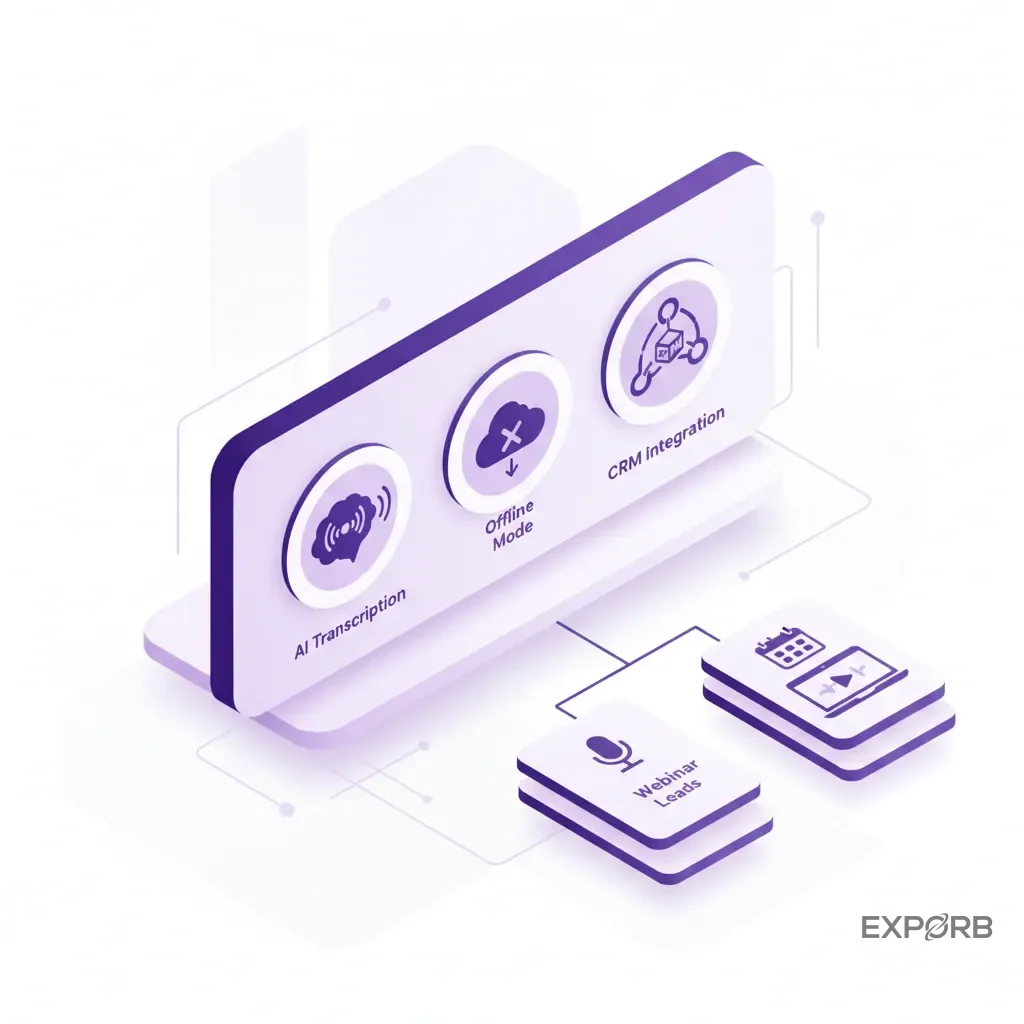
AI-powered transcription and conversation summaries
This is the most significant evolution in event lead capture. The ability for your team to simply talk into their phone for 30 seconds after a conversation and have that audio automatically transcribed, summarized, and analyzed is a true advantage.
Look for:
- High-Accuracy Transcription: It needs to work well in a noisy environment.
- AI Summarization: It shouldn't just transcribe; it should pull out key entities like pain points, next steps, competitors mentioned, and budget.
- Actionable Insights: The best tools will even suggest the next action or score the lead based on the conversation content, providing true AI lead scoring.
This moves you from simple data entry to genuine business intelligence.
Offline reliability and universal badge scanning
This is non-negotiable. Conference center Wi-Fi is notoriously terrible. Any tool that relies on a constant internet connection to function is a tool that will fail you at the most critical moment.
Your team must be able to capture everything—business card scans, voice notes, photos, custom fields—while completely offline. The app should store everything locally on the device and then sync automatically and smoothly once a connection is re-established. Test the offline mode of any tool you consider. If it's clunky or limited, walk away.
On badge scanning, universality is key. Many events have proprietary badge tech. A tool that only scans one type of QR code isn't useful. Look for solutions that can handle a variety of formats or, better yet, focus on the more universal format of business cards, which are always present.
Deep, native CRM integration (not just a CSV file)
Getting your data out shouldn't be a chore. A simple CSV export is the bare minimum, but it's not a real integration. It still requires manual cleanup and uploading, which introduces delays and errors—the very things you're trying to eliminate.
Look for deep, native integrations with your CRM of record, like Salesforce or HubSpot.
- Field Mapping: Can you map your custom capture fields directly to the correct fields in your CRM?
- Automatic Creation: Does it create new leads/contacts automatically, or update existing ones without creating duplicates?
- Rich Data Sync: Does it push over all the rich data—the conversation transcript, the AI summary, links to photos—into the CRM activity timeline?
The goal of a great CRM export is to make the data instantly actionable for your sales team without any manual intervention. The lead should appear in the CRM fully enriched and ready for follow-up within minutes of the sync.
How should you measure the ROI of a hybrid lead strategy?
If you're still measuring your event program's success by Cost Per Lead (CPL), you're doing it wrong. CPL is a relic of an era when all leads were treated equally. In a sophisticated, hybrid strategy, you need more nuanced metrics that reflect the unique contribution of each channel.
You need to measure influence, velocity, and efficiency—not just raw numbers. This requires a shift in how you think about attribution and lead scoring.
Moving beyond CPL to pipeline influence and efficiency
Instead of CPL, start tracking these metrics:
- Pipeline Influence: Of all the deals closed this quarter, what percentage had an in-person event as a key touchpoint? What about a webinar? Good attribution software can show you this. You'll often find that while events generate fewer raw leads, they influence a much higher percentage of your total revenue.
- Cost Per Meeting: This is a much better metric for events than CPL. How much did it cost to generate each qualified sales meeting? This focuses on quality over quantity.
- Sales Cycle Length by Channel: Do leads that originate from events close faster or slower than leads from webinars? What about leads that touch both channels? Often, you'll find the hybrid leads are the fastest of all.
These metrics tell a much richer story about how your channels are actually contributing to the bottom line.
Channel-aware lead scoring models that work
Your lead scoring model needs to understand the different intent signals from each channel. Don't give a lead 10 points for a webinar attendance and 10 points for a badge scan. The intent's wildly different.
A better model might look like this:
- Webinar Registration: +5 points
- Webinar Attendance (>75%): +15 points
- Webinar Q&A Question: +25 points
- Event Badge Scan (Generic): +10 points
- Event Booth Conversation (Notes Captured): +50 points
- Event Booth Conversation (Mentioned "Budget" or "Timeline"): +75 points
This model recognizes that a substantive in-person conversation is one of the strongest buying signals you can get. It requires a capture tool that can provide the data needed to score based on conversation content, but it results in a much more accurate prioritization for your sales team.
Attributing revenue to in-person and digital touchpoints
Multi-touch attribution is the holy grail here. It's rare that a single touchpoint is responsible for a deal. A prospect might see a LinkedIn ad, attend a webinar, talk to you at a trade show, and then attend another webinar before they buy.
Which channel gets the credit? The answer's simple: all of them.
Work with your RevOps team to implement an attribution model (e.g., U-shaped, W-shaped) that gives partial credit to each significant touchpoint along the buyer's journey. This is the only way to truly understand the synergistic effect of your hybrid strategy. You'll stop asking "Should we do events or webinars?" and start asking "What is the optimal mix of events and webinars to accelerate our pipeline?"
Your 90-day plan to connect event and webinar lead capture
Thinking about a unified strategy is one thing. Implementing it's another. Here's a practical, 90-day plan to get you from siloed channels to a connected revenue engine. Don't try to boil the ocean. Just focus on these three core steps.
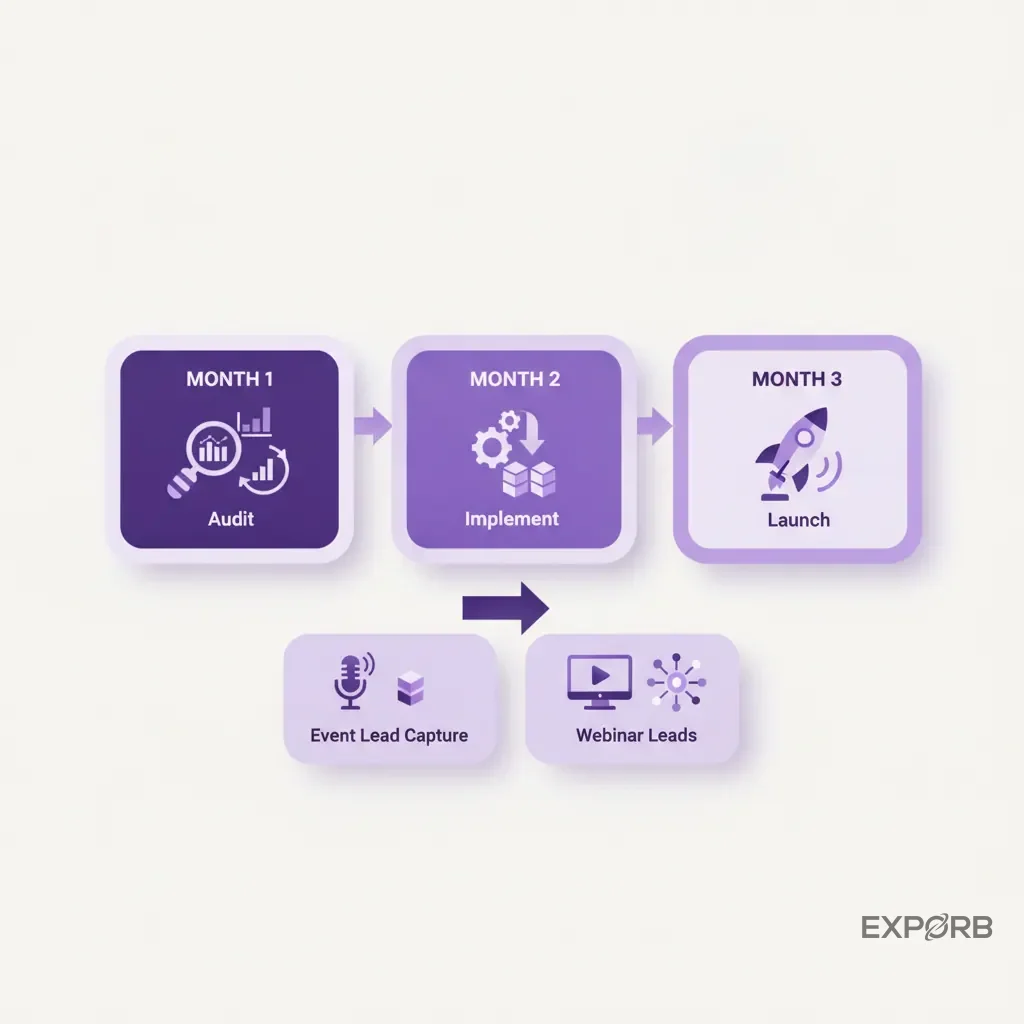
Month 1: Audit your current tech stack and follow-up process
Before you can build, you need a blueprint of what you have. For the first 30 days, focus entirely on discovery.
- Map the current process: Whiteboard the entire lifecycle of an event lead and a webinar lead in your organization. Where does the data come from? Where does it go? Who is responsible at each step?
- Calculate your speed-to-lead: Get the real numbers. Pull a report from your CRM. What's the average time between a lead being created from an event and the first sales activity being logged? Be brutally honest.
- Review your tech stack: What are you using now? Is it just a spreadsheet and a badge scanner rental? Is your webinar platform integrated with your CRM? Identify the gaps and bottlenecks.
Month 2: Implement an AI-powered event capture tool like Exporb
With your audit complete, it's time to fix the biggest gap you likely found: capturing structured data at events. In month two, select and roll out a modern lead capture tool.
- Select a vendor: Run a pilot with a tool that offers the key has we discussed: AI summaries, offline reliability, and deep CRM integration.
- Train the team: This is critical. The tool's only as good as the team's adoption. Run training sessions. Make it clear that "if it's not in the app, it didn't happen."
- Configure the integration: Set up the CRM integration to map fields correctly and ensure data flows automatically, without manual steps. At Exporb, we built our tool to connect directly to your CRM (/has/crm-export) to eliminate the dreaded post-show data entry.
Month 3: Launch your first integrated pre-show and post-show webinar sequence
Now it's time to execute the playbook. Pick your next major trade show and build your first integrated campaign around it.
- Launch your pre-show webinar: Four weeks before the event, run the warm-up webinar for your target account list.
- Execute at the show: Use your new tool and process to capture every conversation with rich context.
- Launch your post-show webinar: Within two weeks of the event, run your segmented, deep-dive webinar for the high-intent leads you identified.
- Measure everything: Track the results. How many meetings did you book from the pre-show webinar? What was the quality of the leads captured at the event? How many deals did the post-show webinar accelerate?
This 90-day sprint will build the foundation for a completely new approach to lead generation—one that finally connects your most powerful channels into a single, unstoppable engine for growth.