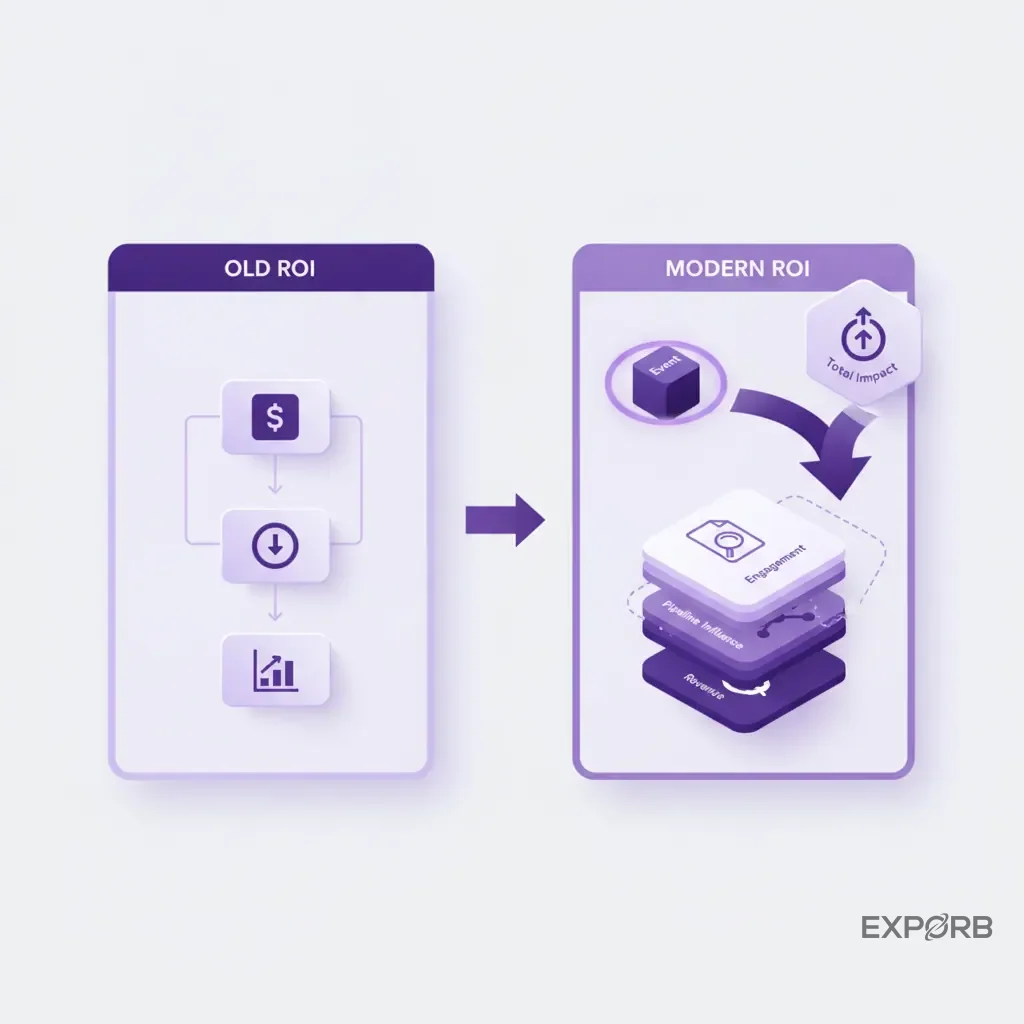
You've probably seen the old Event ROI formula. It looks simple, clean, even elegant. But it's dangerously misleading. You take the revenue you think came from the event, subtract the cost, and divide by the cost. The problem? That formula just doesn't work anymore. It's a relic from an era of Rolodexes and handshake deals. It can't capture the complexity of modern B2B sales cycles. Effective event ROI requires a deeper look than a simple calculation.
Your team spends three days on their feet. Your company spends $100,000 on a booth. You come back with a list of names. Is that success? The old formula might whisper "maybe," but your CFO is shouting harder questions. Imagine the fishbowl full of business cards that nobody will follow up on.
Moving beyond vanity metrics like registrations and attendance
For years, we've measured event success by counting bodies. How many people registered? How many showed up? How many fishbowls full of business cards did we collect? These are vanity metrics. They feel good to report, sure, but they don't tell you anything about actual business impact.
A packed booth doesn't equal a packed pipeline. High attendance doesn't mean high intent. You need to track engagement, conversation quality, and pipeline velocity. Foot traffic alone won't cut it.
The problem with short attribution windows in long sales cycles
Your product might have a six, nine, or even twelve-month sales cycle. So why are we trying to attribute revenue to an event that happened last week? It's a mismatch. A lead from CES in January might not close until September. If your attribution window is only 30 days, that deal looks like it came from thin air. You've lost the connection.
According to B2B Insiders, a modern framework requires you to set realistic measurement windows. Think 30, 90, and 180 days. This depends on the event type and your typical sales velocity.
Introducing the modern event ROI: a complete measurement system for the entire funnel
Modern event ROI isn't a single number; it's a dashboard. It's a collection of metrics that tell a story about the entire customer journey. This system tracks how an event influences deals, accelerates the pipeline, and builds relationships. It does this even if the event wasn't the first or last touchpoint. It focuses on influence, not just origination.
What essential data should you capture before, during, and after an event?
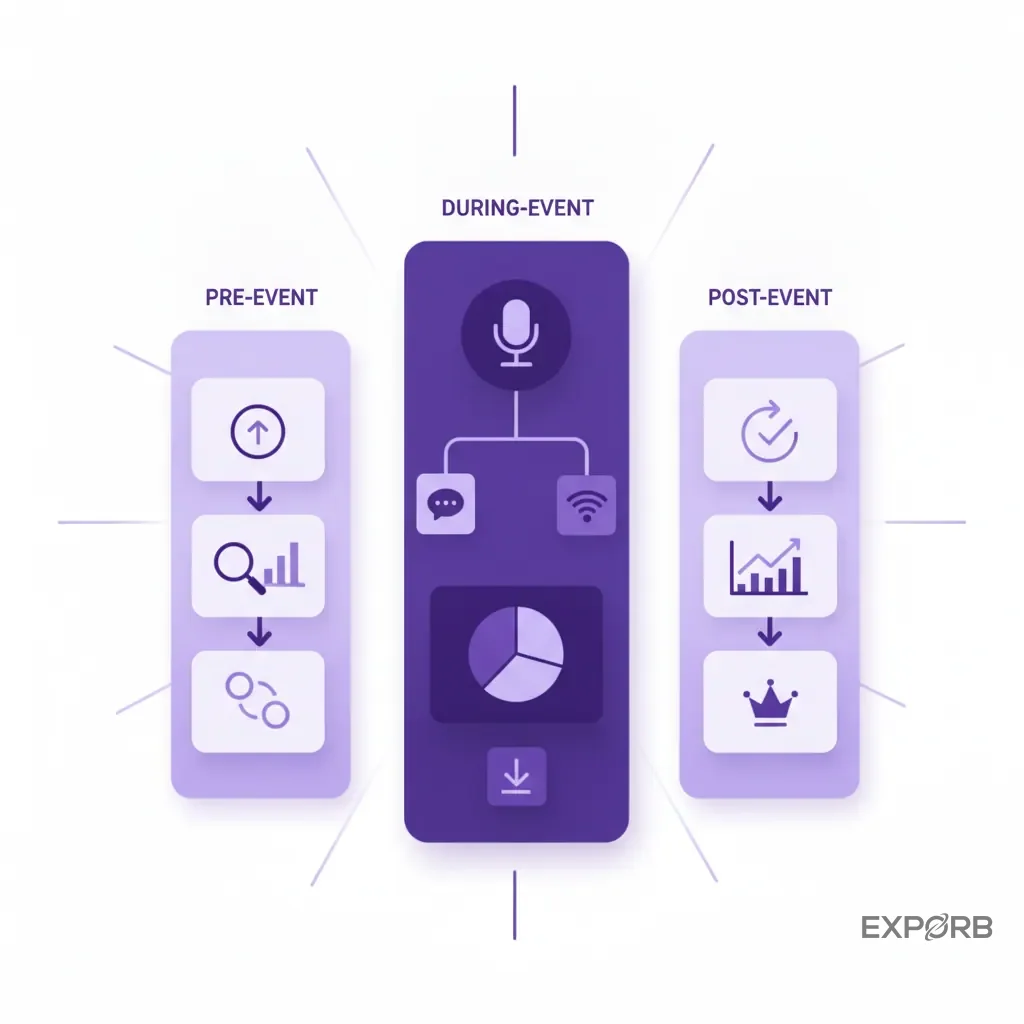
To measure ROI correctly, you need the right inputs. That data collection starts long before you set foot on the trade show floor. It's a continuous process. It turns a one-off event into a rich source of business intelligence.
Pre-event data: shaping strategy with registration insights and segmentation
Your first data points come from your registration process. Don't only ask for a name and email. Instead, use this chance to segment your audience from the start. What do you need to know?
- What's their job title, and how big is their company?
- What are their primary pain points? (A multiple-choice question works best here.)
- What products or topics interest them most?
This data helps you tailor your booth demos, staff your booth with the right experts, and schedule pre-booked meetings with high-value prospects. It's strategic.
On-site data: capturing conversations and intent with first-party data
This is where most exhibitors fail. They rely on a badge scan, which gives them basic contact information and nothing else. You get a name. But you lose the entire conversation. What did you talk about? What was their budget? Who are the decision-makers? All gone.
Capturing this first-party data—the actual context of the conversation—is the single most important activity at your booth. This means detailed notes, qualifying questions, and a system to record it all. Without this, your follow-up is generic and ineffective. It's a wasted opportunity. A good trade show lead capture process isn't negotiable; it's essential.
Post-event data: measuring pipeline influence and attendee satisfaction
The work isn't done when the event ends. Now you connect your on-site data to your CRM and Marketing Automation platforms. Track how many leads convert to Marketing Qualified Leads (MQLs), then to Sales Qualified Leads (SQLs), and finally to closed-won deals. This shows the journey.
You should also send out a post-event survey. Ask about their experience, the value they received, and their likelihood to recommend your brand (Net Promoter Score). This qualitative data is just as important for proving the event's overall value. It adds another layer of insight.
Related: [The Ultimate Trade Show lead capture Guide](/blog/trade-show-lead-capture-guide)
How do you build a data-driven event ROI framework from scratch?
You don't need a team of data scientists to build a solid framework. You just need to be deliberate about what you measure, which tools you use, and how you attribute success. It's about creating a system before the event. Don't try to make sense of a messy spreadsheet afterward. That's a recipe for headaches.
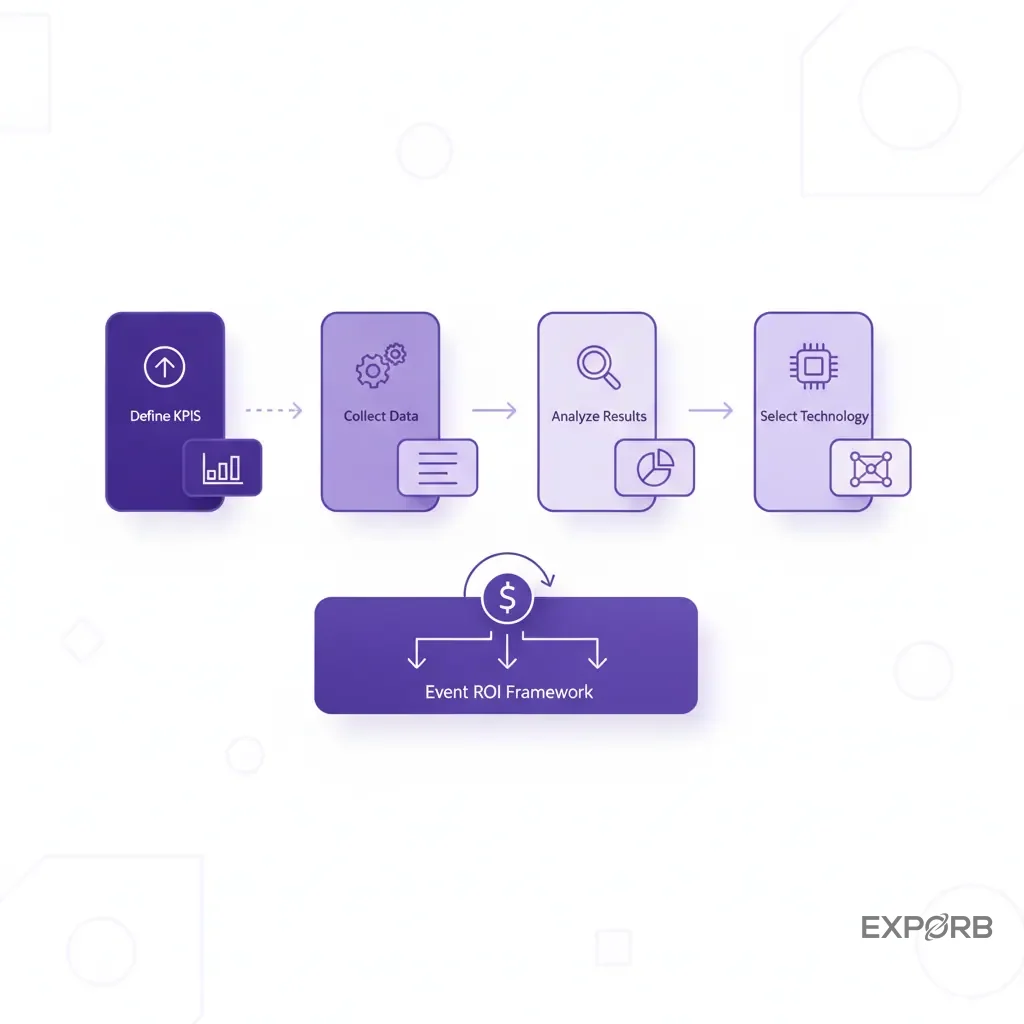
Step 1: define your key performance indicators (KPIs) for sales and marketing
Before you do anything else, get your sales and marketing leaders in a room. You need to agree on what success looks like. Your KPIs should be a mix of marketing and sales metrics.
- Marketing KPIs: Cost per Lead, MQLs Generated.
- Sales KPIs: SQLs Generated, Pipeline Influenced ($).
According to SquadUP, your list of metrics should cover everything from registration conversion to lead generation rate. Make it full.
Step 2: select your technology stack for smooth data flow
Your tech stack is the plumbing that makes your framework possible. You need tools that talk to each other. This avoids manual data entry, which is slow and full of errors.
Your stack should include:
- Registration Platform: To capture pre-event data.
- Lead Capture App: To gather rich, contextual data on-site.
- CRM & Marketing Automation Platform: These two form your central source of truth for customer data and lead nurturing.
- Business Intelligence (BI) Tool: To visualize the data and build your ROI dashboard.
The goal? A smooth, automated flow of data from the first touchpoint to the final report.
Step 3: establish your multi-touch attribution model and reporting windows
How will you give credit to the event? Single-touch attribution (first or last touch) is simple, but it's often inaccurate. A multi-touch attribution model is better. It distributes credit across all the touchpoints that influenced a deal.
Common models include Linear, Time-Decay, or U-Shaped. Choose one that reflects your sales cycle and stick with it. Then, define your reporting windows (e.g., 30, 90, 180 days). This means you're consistently measuring the event's long-term impact.
How can you use real-time data to optimize performance on the trade show floor?
Why wait until after the show to find out what worked? With the right tools, you can make adjustments in real time, turning a good event into a great one. The trade show floor is a dynamic environment. Your strategy should be dynamic too.
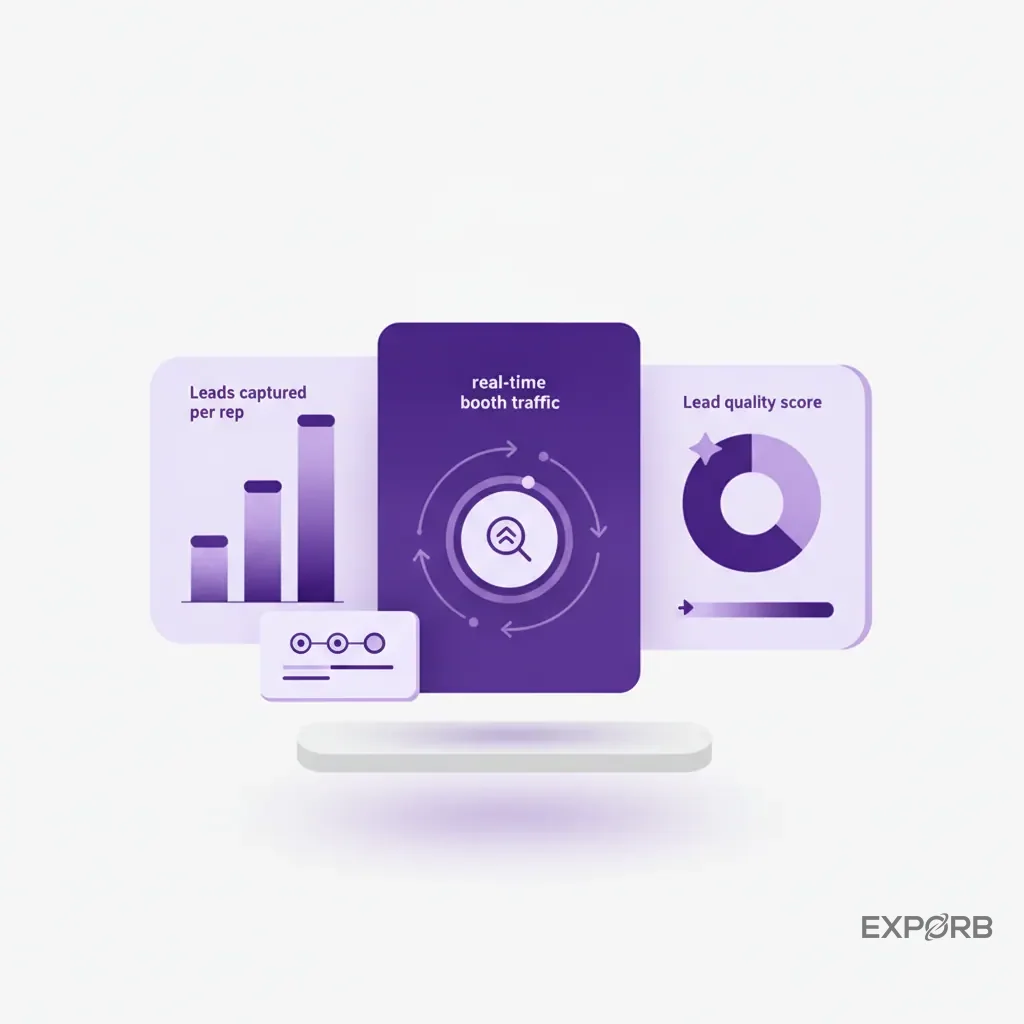
Using live dashboards to monitor booth traffic and engagement
Modern lead capture platforms provide live dashboards. You can see—at a glance—how many leads each team member has captured, their quality, and which messages are resonating. If you see a spike in traffic after a particular product demo, you know to run that demo more often. If one team member is lagging, offer coaching on the spot. Instant feedback.
Adjusting staffing and messaging based on lead quality, not just quantity
A live leaderboard showing leads per rep can be a powerful motivator. But it can also encourage your team to chase quantity over quality. The best systems don't just count scans; they score leads. That's the key.
If you see your team is capturing a lot of low-quality leads, huddle up. Refine your qualifying questions. Maybe your opening pitch is attracting the wrong audience. Real-time data lets you pivot your strategy in hours, not months.
Personalizing demos and conversations on-the-fly with captured insights
Imagine a prospect visits your booth on Day 2. A team member scans their card. The app instantly shows that another colleague spoke with them on Day 1 and recorded a key detail—like their frustration with a competitor's product.
Now, your demo isn't generic. It's a targeted solution to a known problem. This level of personalization's impossible when your "data" is just a stack of business cards and scattered notes. At Exporb, we built our platform to enable this team collaboration, so everyone has the same context. Exporb enables this team collaboration.
Your team had 100 conversations, but what did they actually learn?
This is the billion-dollar question that haunts every founder and VP of Sales after a trade show. Your team insists the event was a huge success. "Tons of great people!" they'll say. But when you ask for specifics, the details are fuzzy. They're gone.
This is the black hole of Event Marketing. The critical context from hundreds of verbal conversations just vanishes into thin air. It's like shouting into the void.
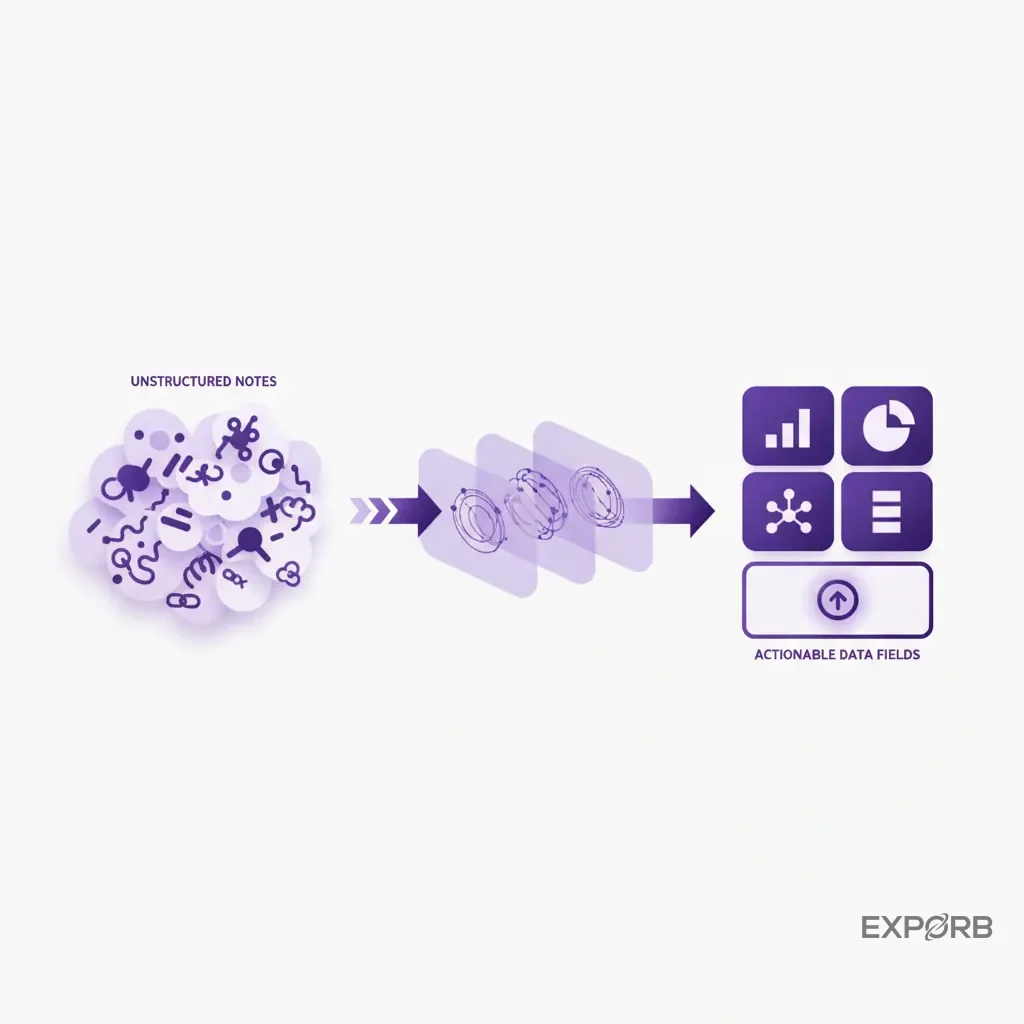
The 'black hole' of verbal conversations and its impact on follow-up
Your team member has a 10-minute conversation with a perfect-fit prospect. They discuss specific pain points, budget constraints, and a clear next step. The team member jots down a few cryptic words on the back of a business card: "Follow up re: Q3 integration."
A week later, that note is meaningless. The context is gone. The follow-up email is a generic "Nice to meet you," and the opportunity dies. You didn't only lose a lead; you wasted a perfect opening. It's a common, costly mistake.
Scenario: turning unstructured booth chats into actionable CRM data
Now, imagine a different scenario. Your team member finishes that same 10-minute conversation. They tap a button on their phone and record a 30-second voice note summarizing the key points: "This is Jane from Acme Corp. They're struggling with data silos and need a solution that integrates with Salesforce. Budget is around $50K for Q3. She needs a proposal by next Friday."
The system automatically transcribes that voice note and attaches it to the lead's contact record. AI pulls out the key entities: pain points, budget, timeline, next steps. When that lead syncs to your CRM, all of this rich, structured data goes with it. We built our system to handle this smoothly.
helping sales with rich context for more effective outreach
Which lead is your sales team more excited to call? The one with just a name and an email? Or the one with a full transcript of their challenges and a clearly defined next step?
It's not even a contest. When you capture the context of the conversation, you're not handing off a "lead." You're handing off a nearly-closed deal. The follow-up isn't a cold call; it's the continuation of a warm conversation. This is how you close event leads faster and justify your event spend. It's that simple.
From messy badge scans to clean CRM data: mastering the data handoff
The moment of truth for your event data is the handoff—the point where it moves from your capture tool into your CRM. This is where most event ROI strategies fall apart. A successful handoff needs discipline, standardization, and automation. Without them, you're in trouble.
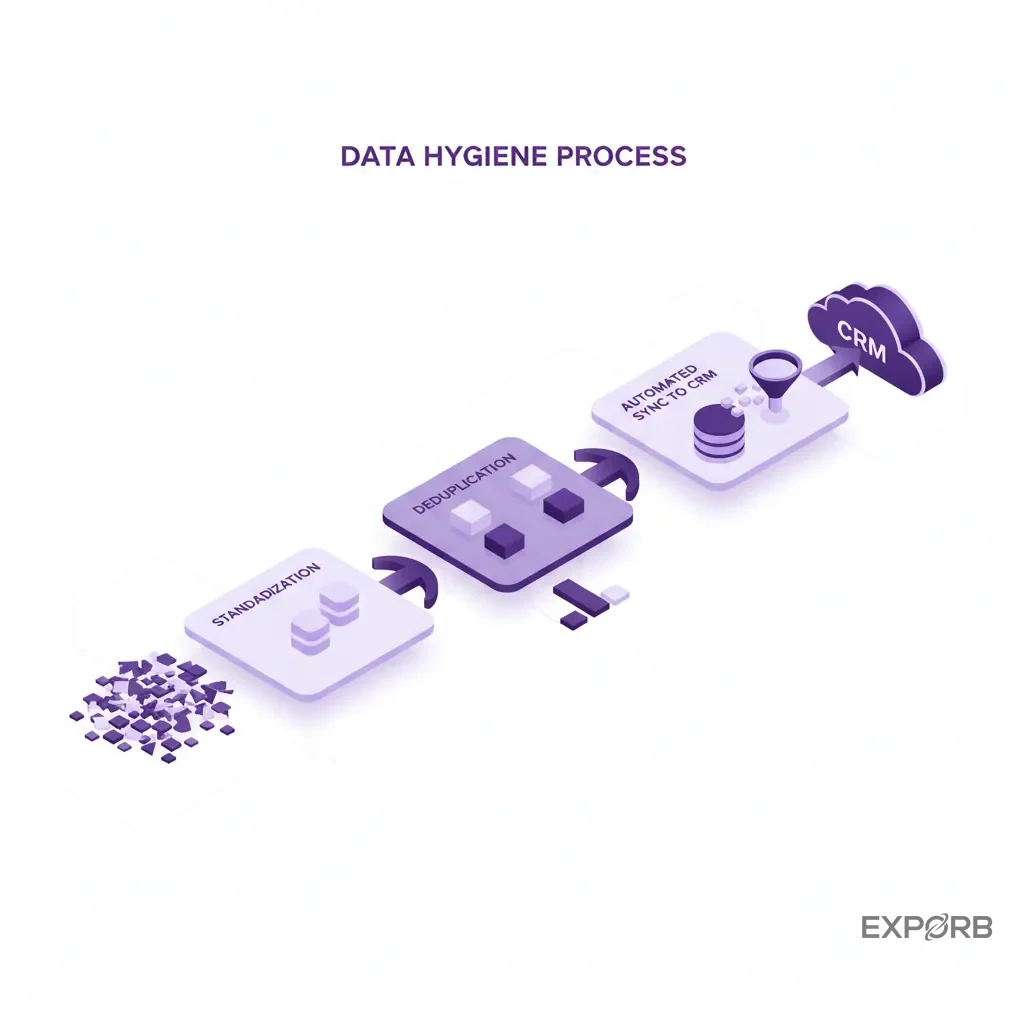
The critical importance of data hygiene and governance for credibility
If you import a CSV file full of duplicates, typos, and incomplete records into your CRM, you've created a nightmare for your sales team. Worse, you've destroyed your credibility. No one will trust the data. Everyone will ignore your beautiful ROI dashboard because everyone knows its foundation is garbage.
Data hygiene isn't a "nice to have." It's everything.
Implementing standardized fields and automated deduplication rules
Your lead capture tool and your CRM must speak the same language. This means using standardized picklist values for fields like "Job Function" or "Industry." Don't let your team type these in manually. That's asking for trouble.
Your system should also automatically check for duplicates. If a contact already exists in your CRM, the event data should enrich the existing record, and not create a new one. A single contact record should show every touchpoint—including the latest trade show conversation. No messy duplicates.
A practical workflow for syncing event data with your CRM
A clean data handoff isn't magic. It's a process.
- Standardize & Automate: Before the event, ensure your lead capture app's fields match your CRM exactly. Use a tool that scans business cards and captures structured notes to minimize manual entry.
- Review & Clean: Have one person review the captured data at the end of each day for any obvious errors. Catch mistakes early.
- Automated Sync: Use a native integration or a tool like Zapier to automatically push clean leads into your CRM. Avoid manual CSV uploads whenever possible; they're slow and error-prone. At Exporb, we built our platform to focus on a pristine CRM export, ensuring the data you've captured arrives cleanly in your system of record.
Comparison of Manual vs. Automated Event Data Handoff
How do you prove pipeline influence beyond just counting leads?
The most sophisticated marketing teams don't only measure "event-sourced" revenue. They measure "event-influenced" revenue. There's a big difference here, and your CFO needs to understand it. An event can be wildly successful even if it doesn't source a single new lead. That's an important distinction.
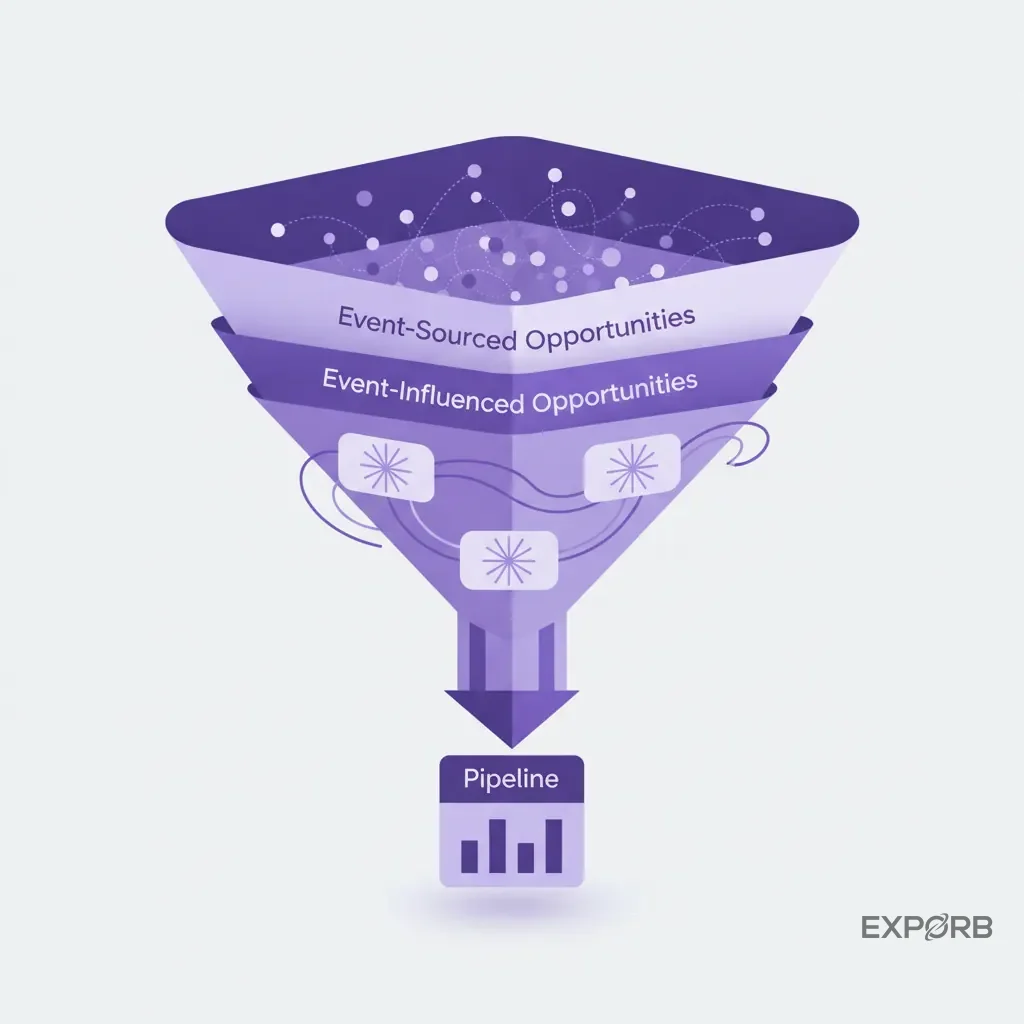
Distinguishing between event-sourced vs. event-influenced opportunities
Here's the difference:
- Event-Sourced: A brand new lead was created at the event, and it eventually became a customer. This is direct, easy-to-track revenue.
- Event-Influenced: A prospect was already in your pipeline. They visited your booth, saw a compelling demo, and that interaction accelerated the deal or increased its value. The event didn't create the opportunity, but it was a key touchpoint on the path to closing.
- Pipeline Acceleration: How quickly did existing deals move after an event interaction?
- Deal Value Increase: Did the event interaction lead to a larger deal size?
According to research from Ticket Fairy, proving this influence is a key demand from sponsors and stakeholders in 2026. You've got to show how your event moves the needle on existing deals.
Setting realistic 30, 90, and 180-day reporting cadences
Don't try to declare victory or defeat the week after the event. Set up saved reports in your CRM that you can review at regular intervals. It's about patience and persistence.
- 30-Day Report: How many leads converted to MQLs/SQLs? How many meetings were booked?
- 90-Day Report: How many opportunities were created? What's the total pipeline value influenced?
- 180-Day Report: How much revenue has closed? What's the final ROI on influenced deals?
This shows you're measuring the event's true, long-term business impact.
Visualizing the event's touchpoint in the overall customer journey
Use a BI tool or your CRM's reporting to create customer journey maps. These visualizations can be incredibly powerful. Show your leadership team a timeline of a major deal. Highlight the event as a key milestone.
For example: "You can see here they were stalled for 60 days. Then they met our lead engineer at the trade show. Two weeks later, they signed the contract." That's a story that proves value far better than any spreadsheet. It's concrete evidence.
Related: How to Use AI for Lead Scoring and Qualification
What metrics truly matter to your sponsors, sales team, and CFO?
You can't use the same report for everyone. Different stakeholders care about different outcomes. A great data-driven event ROI strategy involves creating tailored dashboards for each audience. Tell them exactly what they need to know. No more, no less.
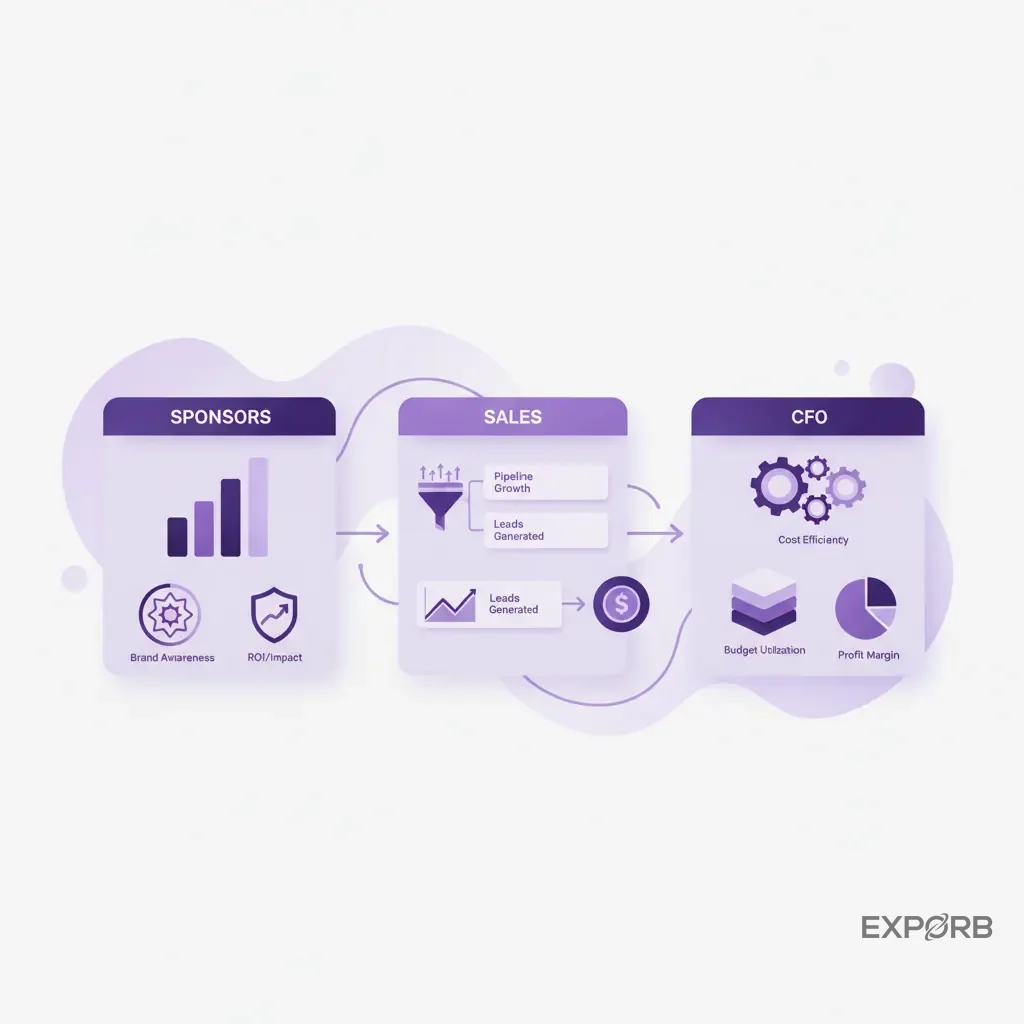
The sponsor's report card: proving value beyond brand exposure
Sponsors are tired of hearing about "brand awareness." They want to see tangible results. Your post-event report to them should include:
- Number of qualified leads delivered.
- Engagement metrics from their sponsored session or booth.
- Direct feedback from attendees about their brand.
This hard data is what'll convince them to sponsor your event again next year. Show them the money.
The sales dashboard: tracking MQLs, SQLs, and influenced pipeline
Your sales team lives in the CRM. They care about one thing: pipeline. Your report to the VP of Sales should focus on:
- Lead Volume & Quality: Total leads passed to sales, plus the MQL-to-SQL conversion rate.
- Pipeline & Sales Cycle: The total dollar value of new and influenced opportunities, alongside a comparison of sales cycle length for event leads vs. non-event leads.
The finance summary: connecting event spend to contribution margin
Your CFO thinks in terms of investment and return. They don't care about MQLs; they care about contribution margin and customer acquisition cost (CAC). Your summary for them should be concise and financial.
- Total Event Cost: The all-in, fully-loaded cost.
- Event-Sourced Revenue: Hard revenue from deals that started at the event.
- Customer Lifetime Value (LTV) to CAC Ratio: Show that the customers acquired through the event are profitable. Prove the investment pays off.
Three common mistakes that sabotage event ROI (and how to avoid them)
We see the same mistakes over and over. Exhibitors show up with a beautiful booth and a terrible plan—or no plan at all. Avoiding these common pitfalls is half the battle in achieving a positive, provable ROI. It's about preparation.
Misconception: focusing on booth design over a data capture strategy
Most exhibitors obsess over booth design and completely ignore lead capture. They'll spend $50,000, $100,000, or more on a stunning booth design, lighting, and swag. Yet they'll spend $0 on their lead capture strategy. They just assume their team will "figure it out" with a rented badge scanner or a spreadsheet.
This is completely backwards. Your booth's job is to attract people. Your data capture strategy's job is to turn those people into revenue. Which one do you think is more important? It's not a trick question.
Failing to align marketing's event goals with sales' revenue targets
Marketing wants to generate 500 leads. Sales wants to close $2 million in new business. If these two goals aren't connected, you're set up for failure. Marketing will declare victory after handing over a list of 500 names, while sales will complain that the leads are all junk. It's a tale as old as time.
The solution is a Service Level Agreement (SLA). Marketing commits to delivering a certain number of SQLs. Sales commits to following up with them within a specific timeframe. Clear expectations.
Ignoring post-event data analysis and continuous improvement
The event isn't over until you've analyzed the data and learned from it. What worked? What didn't? Which sessions had the highest engagement? Which members of your booth staff were the most effective? Ask these questions.
This analysis forms the foundation of your strategy for the next event. Each event should be smarter than the last. Without this feedback loop, you're just guessing. And you'll keep making the same expensive mistakes.
Making data your competitive advantage: your event ROI action plan
It's time to move from theory to action. A data-driven approach isn't just about measurement; it's a competitive advantage. While your competitors are busy sorting through a pile of business cards, you'll be having intelligent follow-up conversations with your best prospects. You'll be ahead.
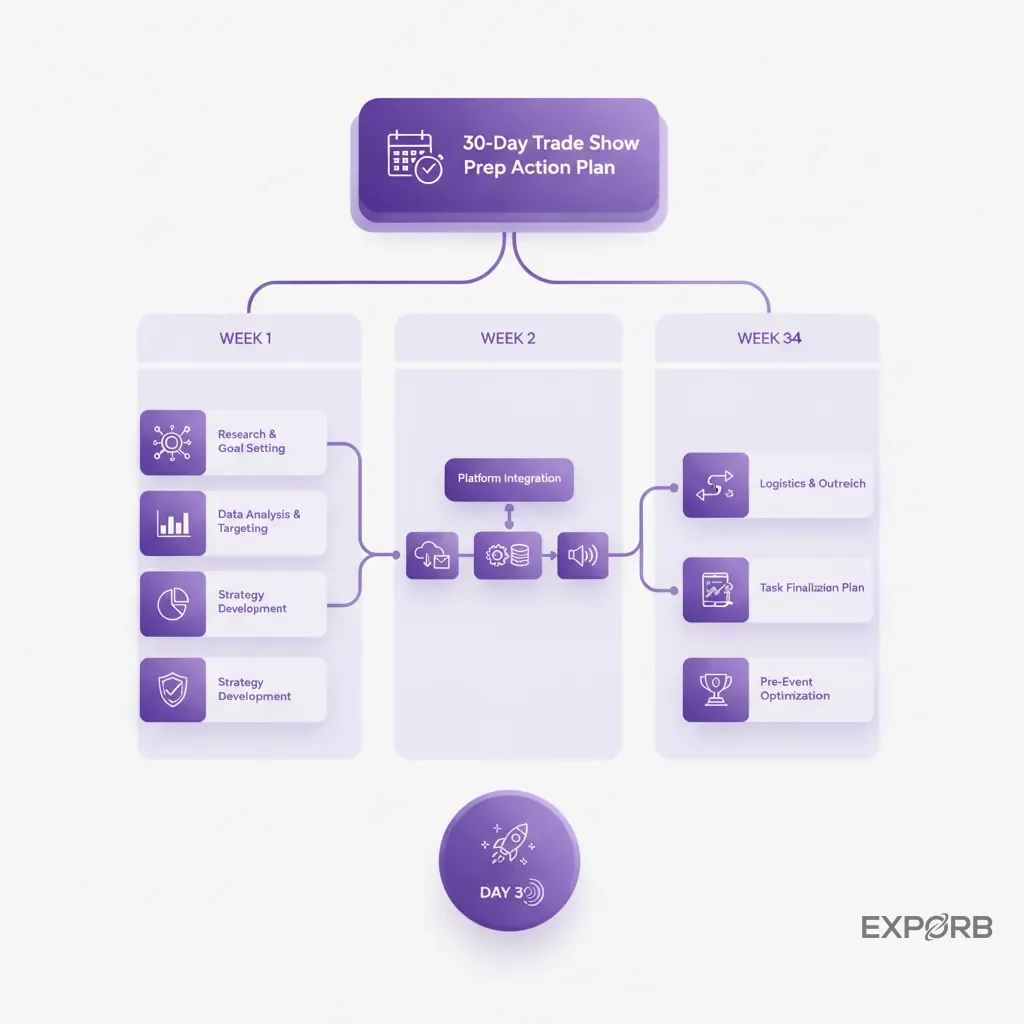
Your 30-day plan to prepare for your next trade show
Here's your 30-day action plan:
- Weeks 1-2: Strategy, Alignment & Tech. Meet with sales and leadership to define KPIs and goals. Finalize your budget. Select and set up your lead capture tech. Standardize your data fields and configure your CRM integration.
- Weeks 3-4: Training & Final Prep. Train your booth staff on the lead capture process, not just the product. Role-play conversations and practice using the app. Test all your technology. Prepare your pre-event marketing campaigns. Ship everything to the venue.
Building your cross-functional event ROI task force
You need a small, dedicated team to own this process. It should include:
- An Event Manager (from marketing, the project lead) and a Sales Operations specialist (to manage the CRM and data flow).
- A Top-Performing Sales Rep (to provide on-the-ground feedback) and a Data Analyst (to build and maintain the ROI dashboards).
A checklist for continuous measurement and improvement
This isn't a one-time project. It's a new way of operating.
- Did you define clear KPIs before the event?
- Did you use a modern tool to capture rich, contextual data, and sync it cleanly to your CRM?
- Did you measure both sourced and influenced pipeline?
- Did you hold a post-mortem to analyze the results and identify improvements for next time?
By following this plan, you'll transform your events from an expensive line item into a predictable, measurable engine for revenue growth. You'll finally prove your marketing impact.