
Why most trade show follow-up email templates fail in 2026
You've just spent $50,000 on a booth, flights, and hotels. Your team collected a fishbowl full of business cards and scanned hundreds of badges. A week later, you blast out a generic "nice to meet you at [Event Name]" email to everyone. The result? A 2% reply rate and a pipeline that's still empty. The right trade show follow-up email templates fix this — but most exhibitors never get past the generic blast.
The entire approach is broken. The problem isn't your email template. It's the huge gap between the conversation at the booth and the message that lands in their inbox.
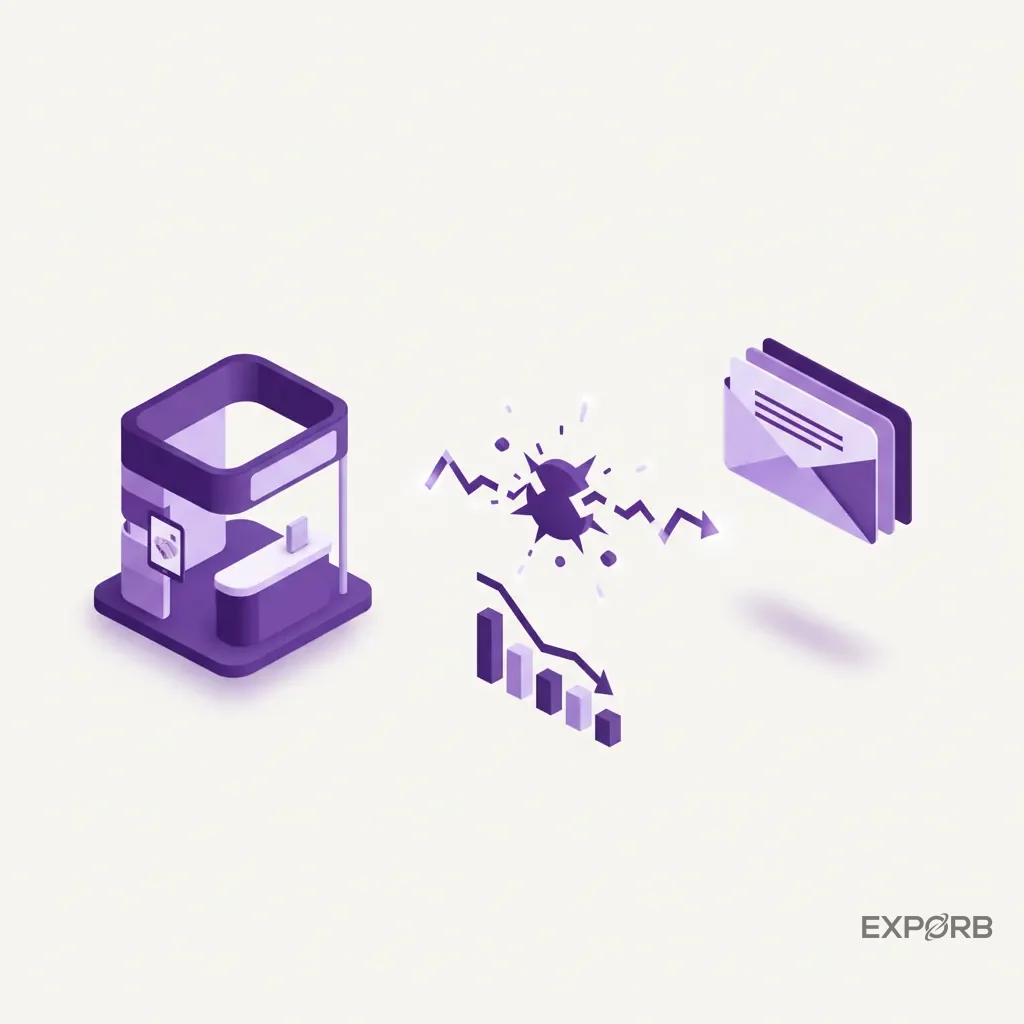
The fatal disconnect between booth conversations and inbox follow-up
When a prospect leaves your booth, the clock starts ticking. Fast. They've spoken to dozens of vendors. Your company, your product, and the specific problems you discussed are already fading from their memory. A generic email a week later doesn't jog their memory; it just confirms they were another faceless lead on a list.
Getting their email address isn't the real value. The conversation is. What did they say their biggest challenge was? Did they mention an unhappy competitor? Were they on a specific timeline? This context turns a cold follow-up into a warm conversation. Without it, you're just guessing.
Challenging the myth: why speed without context is just spam
Everyone says to follow up fast. They're right, but it's only half the story. A fast, generic email is just high-velocity spam. It proves you're efficient at exporting a list, not that you listened.
According to research from Markempa, 38% of exhibitors take six days or longer to follow up. This creates a huge opportunity, but only if you use the time wisely. The goal is to be first with a message that matters. A personalized email that says, "You mentioned you're struggling with X, here's how we solve that," will beat a generic "checking in" email every time, even if it arrives a day later.
The high cost of generic 'nice to meet you' templates
What's the real cost of a bad follow-up strategy? It costs more than the marketing spend on the event. You lose the pipeline you didn't build, the deals you never had a shot at, and the brand equity you damage by sending impersonal emails. You're turning high-intent prospects—people who physically walked up to your booth—into unsubscribes.
Trade shows generate the highest-quality leads for 73% of B2B marketers, according to research from the Center for Exhibition Industry Research (CEIR). Wasting these leads with lazy follow-up is like drilling a hole in your most valuable bucket.
How can you prepare for follow-up before the show even starts?
Your follow-up strategy shouldn't start when the trade show ends. It starts before you even book your booth. Most exhibitors obsess over booth design and completely ignore lead capture. They spend $50K looking good and $0 on remembering what was said. The most successful exhibitors make lead capture and follow-up a core part of their event plan, not an afterthought.
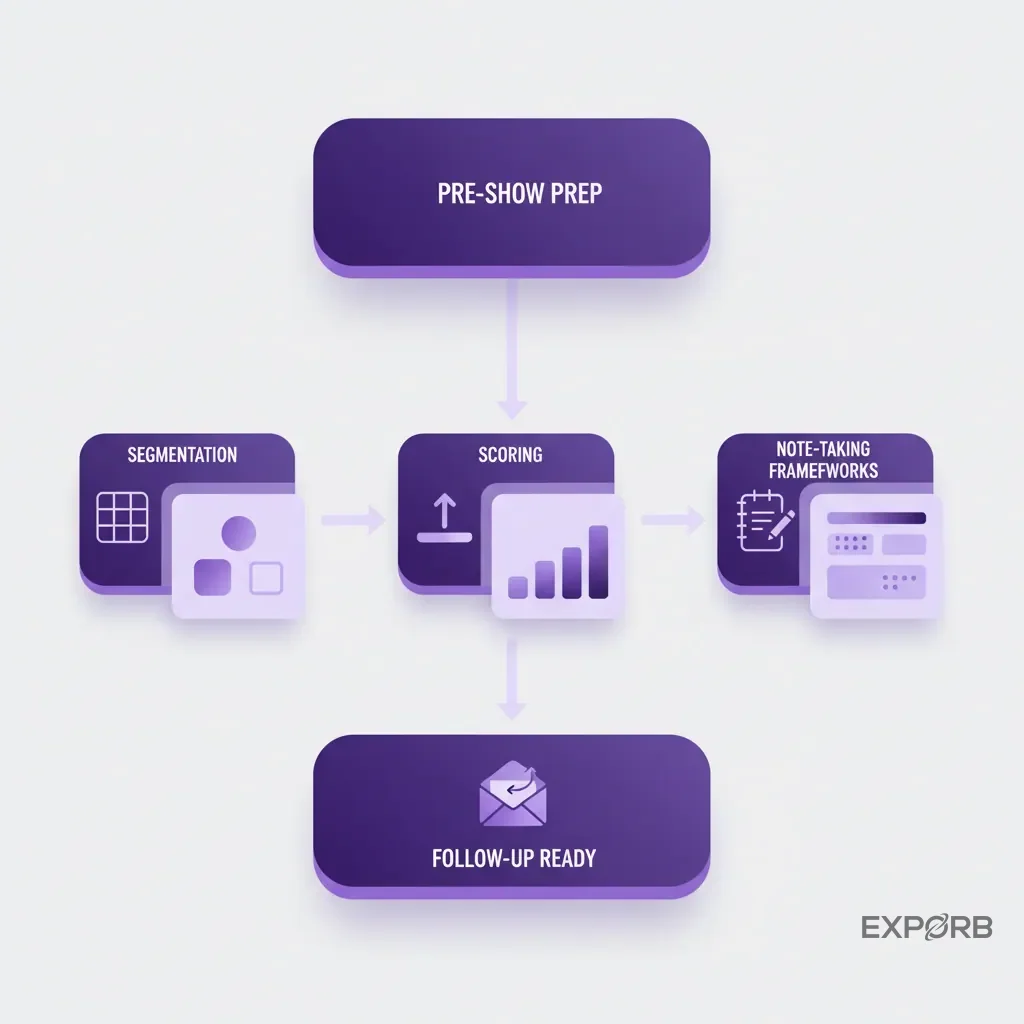
Building your lead capture framework: segmentation, scoring, and notes
Before your team talks to a single person, you need a system. Don't leave it to scribbled notes on the back of a business card. Define your process:
- Lead Segmentation: What are your key buckets? Are you looking for potential customers, partners, or press? Create simple tags your team can apply on the spot (e.g.,
Customer-Hot,Partner-Exploratory,Press-Contact). - Lead Scoring: What makes a lead a 10/10? Is it budget, title, company size, or a specific pain point? Define 3-4 key qualifying questions and a simple scoring system (e.g., 1-5 scale) your team can use to rank every conversation.
- Note-Taking Structure: What information is non-negotiable? Don't just hope your team remembers. Create a template with required fields: Key Pain Point, Current Solution, Timeline, Next Steps. This forces consistency and captures the context you need for personalization.
- Tool Selection: Choose and configure the app your team will use on the floor. Make sure everyone is logged in and comfortable with it before the show starts.
This framework ensures every lead you capture comes with structured data from the moment of collection. No more week-long data entry marathons trying to decipher a pile of messy notes.
Pre-writing your email sequences for different lead temperatures
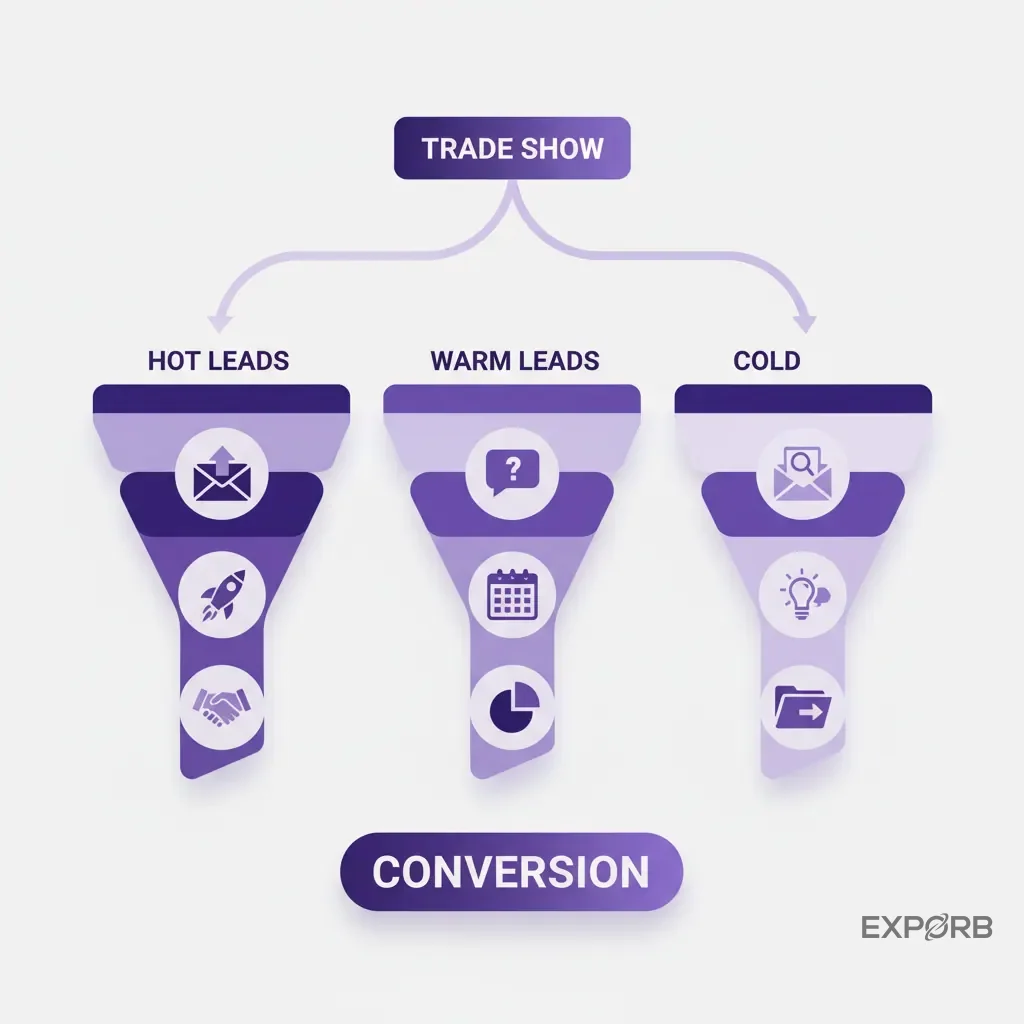
Why write emails from scratch under post-show pressure? You already know you're going to meet hot, warm, and cold leads. Write your follow-up sequences for each segment before the show.
- Hot Leads (High Score): A sequence focused on booking a meeting immediately.
- Warm Leads (Medium Score): A nurturing sequence with valuable content like case studies or webinars.
- Cold Leads (Low Score): A low-pressure sequence to keep them on your radar for the future.
Having these templates 80% complete means you only need to spend a few minutes adding the important 20% of personalization from your notes.
Equipping your booth staff to be data collectors, not just pitch-givers
Your booth staff's most important job is listening and recording what they hear. A perfect pitch is secondary. Train them on the lead capture framework you built. Run role-playing exercises where they practice asking qualifying questions and logging the answers in your chosen tool.
Their goal is simple: for every business card they collect, they must also capture the story that goes with it. The better they're at this, the more successful your follow-up campaigns will be.
Related: The Ultimate Guide to Trade Show Lead Capture
These trade show follow-up email templates do one thing: turn booth conversations into pipeline. Download all 8 as a PDF so you have them ready before your next show.
What is the new 24-hour rule for trade show follow-up?
The old advice was to follow up within a week. That's no longer good enough. The new standard is 24 hours. The data is clear: speed, when combined with context, wins. It shows you're organized, attentive, and eager to continue the conversation while it's still fresh in the prospect's mind.
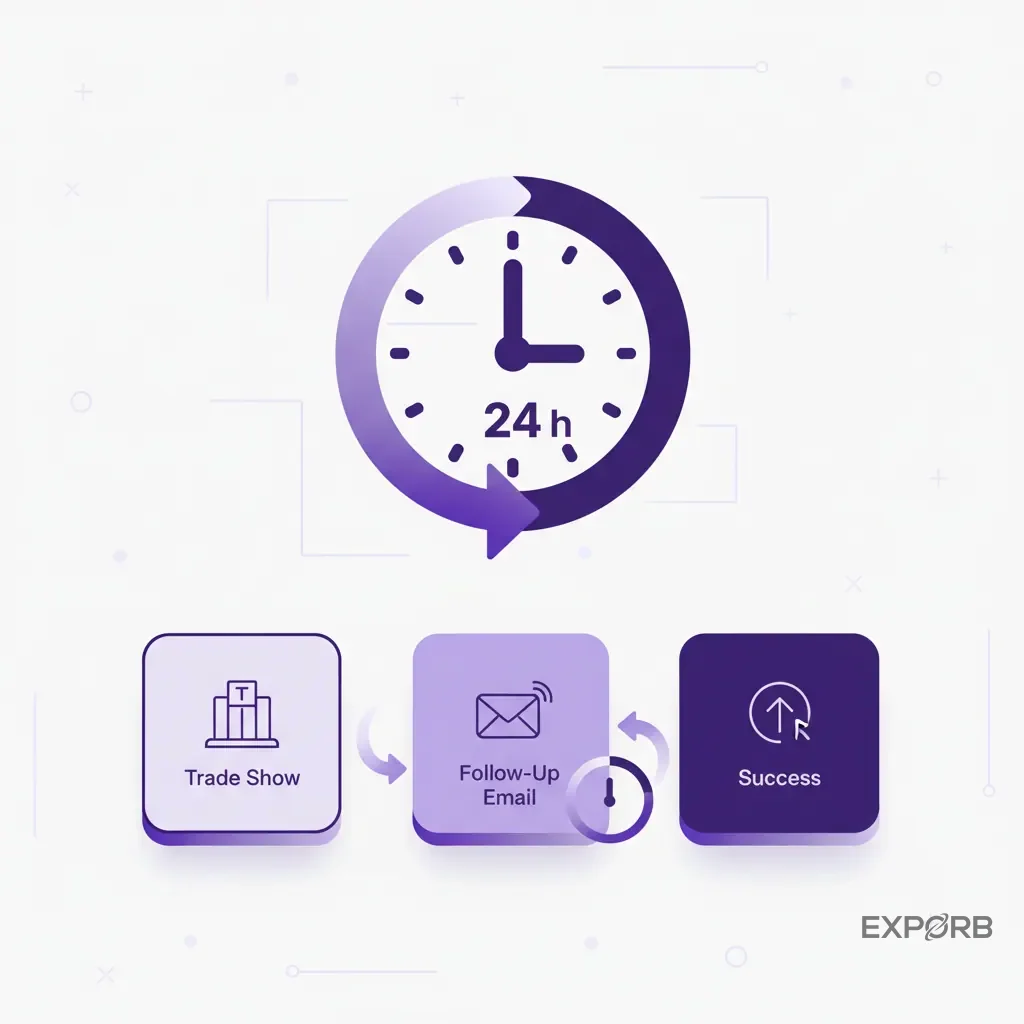
The data-backed case for immediate follow-up (within 24-48 hours)
How much does speed matter? According to aggregated campaign data from Smartlead.ai, B2B sales teams that follow up with trade show leads within 24–48 hours see up to a 60% higher conversion rate. Every day you wait, your chances of booking a meeting drop.
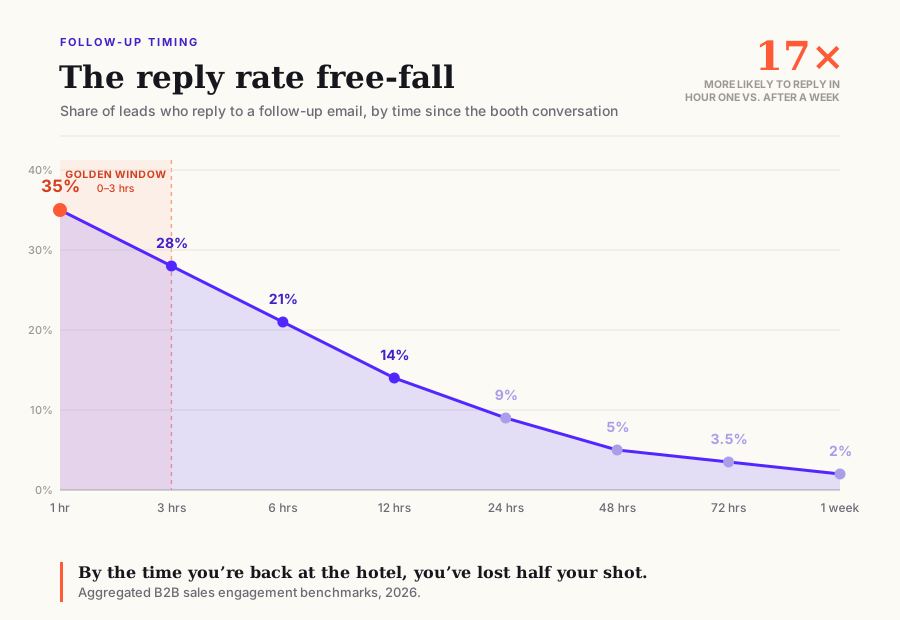
The prospect is at peak interest right after they leave the show floor. They're actively thinking about the solutions they saw. Your goal is to get into their inbox before they get buried in their regular work.
How structured lead capture makes same-day follow-up possible
This is where your pre-show preparation pays off. Most companies wait a week because their lead data is a disaster. It's a pile of unscanned cards, messy spreadsheets, and illegible notes that takes days of manual work to clean up.
A structured lead capture process changes everything. The data is clean from the start. Your team populates a ready-to-use database in real-time. No more cleanup. This means you can export your "Hot Leads" at the end of day one and send personalized follow-ups that same night from the hotel.
Template 1: The immediate 'conversation recap' email
This email is your first and most important touchpoint. It isn't a sales pitch. It's a simple, human confirmation that you were listening.
Subject: Great connecting at [Event Name]
Body:
Hi [First Name],
It was great meeting you at the [Company Name] booth today at [Event Name].
I really enjoyed our conversation about [specific topic you discussed, e.g., "your challenge with managing international shipping logistics"]. It was interesting to hear how you're currently using [their current solution, e.g., "a mix of spreadsheets and manual tracking"].
Based on what you said, I think you might find this [resource, e.g., "case study on how we helped a similar logistics company cut costs"] helpful.
Would you be open to a quick 15-minute call next week to explore this further?
Best,
[Your Name]
Which email templates should you use for hot, warm, and cold leads?
One-size-fits-all follow-up is a recipe for failure. Sending a hard "book a demo" pitch to someone who just casually grabbed a brochure is as ineffective as sending a soft-nurture email to a prospect who explicitly asked for a quote. Your pre-show segmentation work allows you to send the right message to the right person.
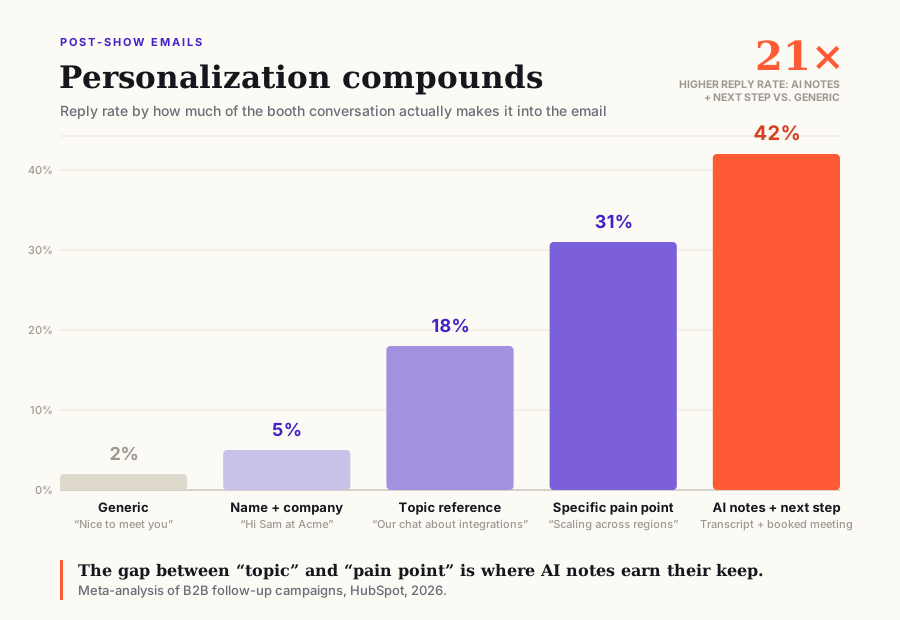
A recent meta-analysis of customer data by HubSpot found that adding just one or two sentences of genuine personalization can increase reply rates by 32%. Your detailed notes become your most powerful asset.
Template 2: The 'hot lead' email for immediate meeting requests
These are the prospects who scored high on your qualification criteria. They have a clear need, the right title, and strong interest. The goal here is singular: book a meeting.
Subject: Next steps after our chat at [Event Name]
Body:
Hi [First Name],
Thanks again for stopping by our booth at [Event Name] yesterday.
Our conversation about [specific pain point they mentioned] really stuck with me. You said your team is looking to [their stated goal, e.g., "implement a new CRM"] before Q3, and I'm confident we can help you hit that deadline.
I have some availability for a brief call on Tuesday or Thursday afternoon to walk you through a tailored demo and answer any questions your team might have.
Does that work for you?
Best,
[Your Name]
Template 3: The 'warm lead' email for nurturing with resources
These leads are a good fit, but their timeline might be longer or their buying intent is less clear. Don't push for a meeting yet. Instead, provide value and position yourself as a helpful resource.
Subject: Following up from [Event Name]
Body:
Hi [First Name],
It was a pleasure meeting you at [Event Name] this week.
I enjoyed learning about how [Their Company Name] is approaching [their industry challenge]. You mentioned you were curious about [a specific topic, e.g., "how AI can improve customer support ticketing"].
I thought you might appreciate our latest report on that exact subject: [Link to Report/Webinar].
No need for a call just yet, but I'd be happy to answer any questions you have after you've had a look.
Best,
[Your Name]
Template 4: The 'cold lead' email for low-pressure re-engagement
These are leads who may have just dropped a card in a fishbowl or had a very brief chat. They're low-priority but shouldn't be discarded. A gentle, low-pressure touchpoint keeps you on their radar without being pushy.
Subject: [Event Name]
Body:
Hi [First Name],
Just wanted to say thanks for stopping by the [Your Company Name] booth at [Event Name] last week.
We met a lot of great people, and I wanted to share a bit more about what we do in case it's relevant for you down the line. We help companies like yours [one-sentence value proposition].
If you're ever exploring new solutions in this area, you can find everything at our website: [Link to your website].
Hope you had a great show.
Best,
[Your Name]
Comparison of follow-up strategies for different lead temperatures.
Free PDF Template
Download All 8 Email TemplatesHow can AI and event data supercharge your personalization?
Manually personalizing hundreds of emails is a huge task. This is where modern tools and data come into play. In 2026, you shouldn't just collect contact information. You need rich data points. AI can then use this data to help you craft deeply relevant follow-up messages at scale.
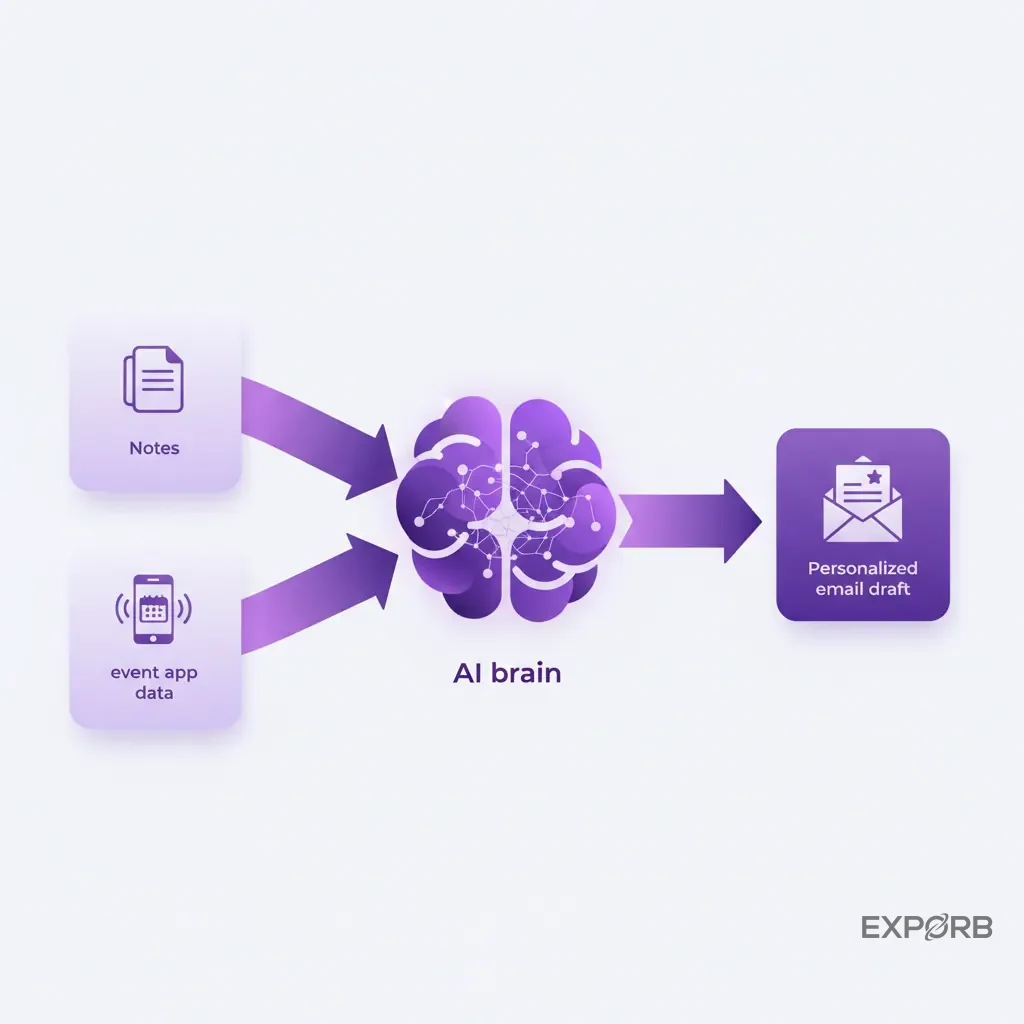
Using AI to turn messy conversation notes into personalized email drafts
Imagine your booth staff records a quick voice note after each conversation. When they're back online, AI can transcribe the audio, identify key pain points and sentiment, and then pre-populate your email templates with that structured data.
Instead of your team manually typing "Prospect was worried about integration costs," the AI can draft a sentence for your email template: "I understand that budget for integration is a key consideration for you, and I'd love to show you how our flexible API can reduce those costs." This saves hours, and you won't forget any important detail.
Using event app data (sessions attended, vendors bookmarked) for hyper-relevance
Many trade shows now have sophisticated event apps where attendees bookmark sessions, speakers, and exhibitors. If you have access to this data (often available through sponsorship packages), you can add another layer of personalization.
For example, you could send a targeted email to everyone who attended a session on "The Future of AI in Manufacturing" with a subject line like, "Thoughts on the AI in Manufacturing talk?" The email can then tie your solution to the themes discussed in that session. This shows you're an active participant in their industry's conversation.
Template 5: The AI-assisted, data-rich follow-up
This template combines structured notes with event data for a level of personalization that's almost impossible to achieve manually.
Subject: Your interest in [Topic of Session They Attended] at [Event Name]
Body:
Hi [First Name],
I saw you attended the session on "[Session Title]" at [Event Name] and also stopped by our booth. Hope you found the talk as insightful as we did.
When we spoke, you mentioned a key challenge for you is [Pain Point from AI-transcribed notes]. The speaker, [Speaker's Name], made a great point about [Relevant Point from Session], which reminded me of how we help [Their Company Name]'s industry solve that exact problem.
We put together a brief guide that expands on that idea: [Link to a relevant, targeted resource].
If you're open to it, I'd be happy to schedule a quick chat to discuss how these concepts apply directly to your goals for Q4.
Best,
[Your Name]
What if your team's conversations are a complete black box?
This is the classic founder's dilemma. You invest a fortune in a trade show. Your team comes back with a list of 200 names, and you have no idea what actually happened. You ask your top rep, "How was the show?" They say, "Great! Talked to a ton of people." You ask, "Who were the best ones?" Blank stare. The data is a black box, and it can take weeks to sort through, by which time most opportunities have gone cold.
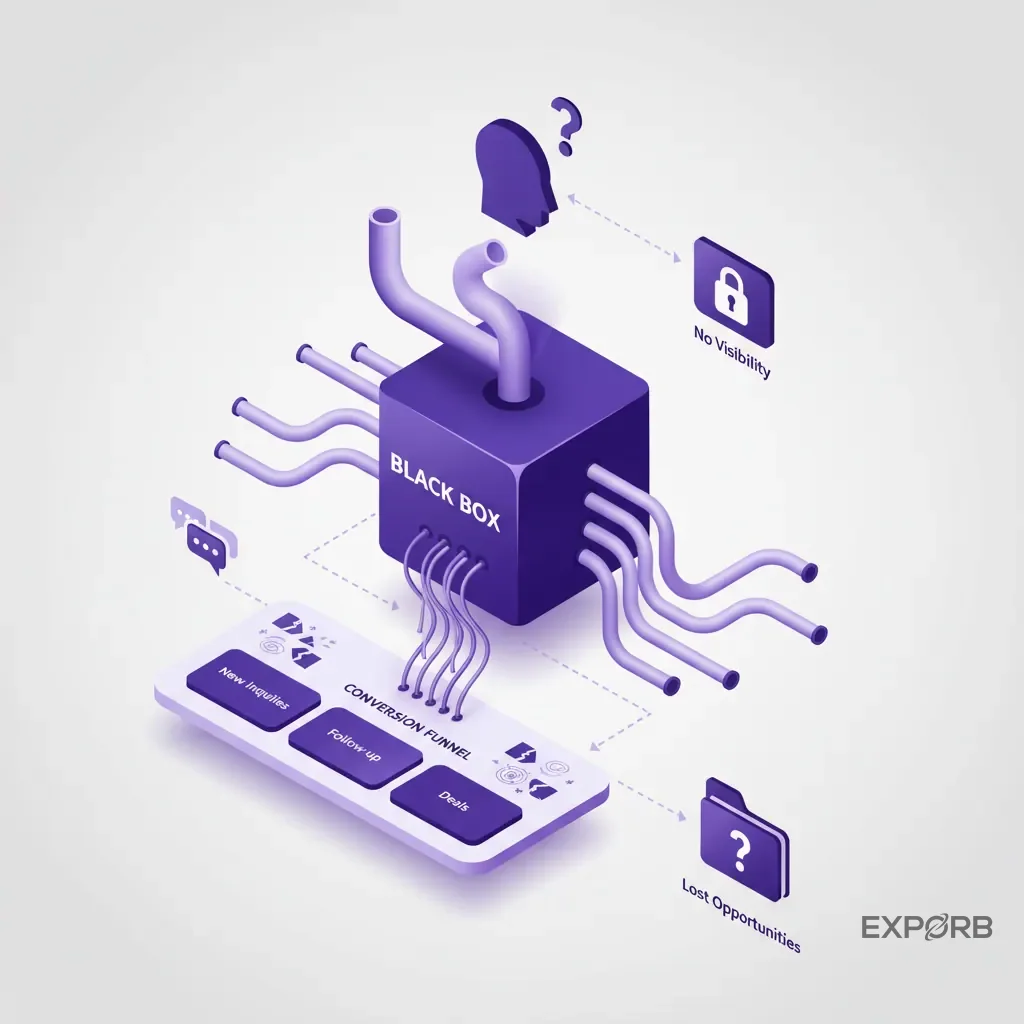
The founder's dilemma: you have leads but no context for what was discussed
Without context, a list of leads is almost useless. You can't prioritize. You can't personalize. You can't forecast. You're forced to treat a CEO who asked for a proposal with the same generic email as an intern who just wanted a free t-shirt.
This lack of visibility is why so many companies fail to see a positive ROI from events. The value isn't the list of names; it's the intelligence from conversations. If that intelligence lives only in your team's heads, it might as well not exist.
How conversation intelligence tools like Exporb provide full visibility
This is precisely the problem we built Exporb to solve. At Exporb, we believe founders and marketing leaders should have complete visibility into every conversation that happens at their booth. This is about strategy, not surveillance.
When your team uses a tool like Exporb, they don't just scan business cards. They're capturing the entire context of the conversation—voice notes, important points, photos of drawings on a napkin, and structured data points. Everything works offline on the trade show floor and syncs to a central dashboard when they're back online. The AI then transcribes the notes and enriches the lead with company data.
As a founder, you can log in and see a real-time feed of every interaction, complete with scores, notes, and AI-generated summaries. You can immediately see which 10 leads are hot and need a personal follow-up from you, and which 100 can be routed to a marketing nurture sequence. You're no longer blind.
Translating booth insights into targeted messaging for leadership
When you have this level of structured data, you can tailor your messaging with incredible precision. If a high-value prospect expressed concern about security, a C-level executive can send a follow-up referencing that specific concern and attaching your company's security whitepaper.
Your follow-up isn't a low-level marketing task anymore. It becomes a strategic sales activity, driven by real intelligence from the show floor.
---Take them to your next show. Download the complete PDF with all 8 templates — fill in the blanks at the booth, or let Exporb do it for you.
Are single follow-up emails a waste of time?
Yes, for the most part. Sending one email and hoping for the best is a low-percentage play. The modern B2B buyer is busy and distracted. Your first email might get buried, missed, or simply saved for later and forgotten. A persistent, value-driven sequence is what breaks through the noise.
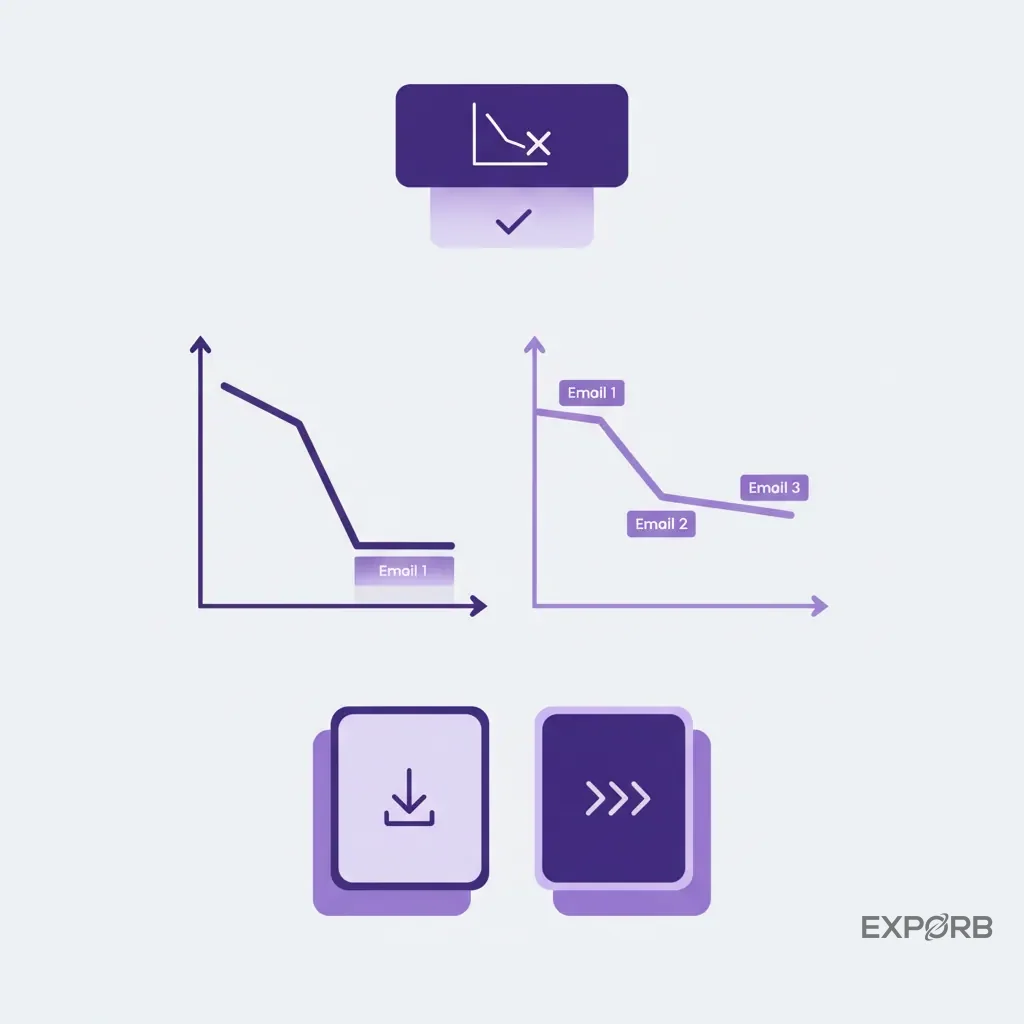
Why a multi-touch email sequence drives 2.4x more meetings
Don't just take our word for it. Analysis of customer campaigns by Default.com shows that multi-touch email sequences (typically 3-5 follow-ups over 14-21 days) drive 2.4 times more meetings from event leads than a single follow-up email.
Persistence pays off, as long as each touchpoint adds value instead of just saying "bumping this up." Your sequence should tell a story, with each email offering a new piece of information or a fresh perspective.
Template 6: The value-add second touch (case study or blog post)
This email should be sent 3-4 days after the first one if you haven't received a reply. It's a gentle nudge that provides more value.
Subject: Re: Great connecting at [Event Name]
Body:
Hi [First Name],
Just wanted to follow up on my last email.
When we spoke at the booth, you mentioned you were dealing with [Pain Point]. It made me think of a situation one of our customers, [Customer Name], was in before they worked with us.
We wrote a short case study on how they [achieved specific result]. You can read it here: [Link to Case Study].
Let me know if this resonates with the challenges you're facing.
Best,
[Your Name]
Template 7: The gentle 'breakup' email to close the loop
If you still haven't heard back after 3-4 touchpoints, it's time to send a final, polite email to close the loop. This often gets a surprisingly high response rate from people who were interested but just got busy.
Subject: Closing the loop
Body:
Hi [First Name],
I've sent a few emails about our conversation at [Event Name] and haven't heard back, so I'll assume now isn't the right time to connect.
I won't follow up again, but please don't hesitate to reach out if your priorities change.
Best,
[Your Name]
Best practices for writing follow-up emails that get replies
Even with the perfect templates and timing, the execution of your email matters. Small details can make the difference between getting a reply and getting ignored.
Crafting subject lines that reference the event and your conversation
Your subject line is your first impression. It needs to be recognizable and relevant. Always include the name of the event for context.
- Bad: "Following up"
- Good: "Great connecting at SaaStr 2026"
- Better: "Our chat about CRMs at SaaStr"
- Best: "Your question about API integrations at SaaStr"
The more specific you can be, the more likely your email gets opened. It'll feel like a personal message, not a marketing blast.
Keeping your email body concise and mobile-friendly (50-125 words)
Nobody wants to read a novel in their inbox, especially on their phone. Research from Boomerang and HubSpot shows that emails between 50 and 125 words generate the highest response rates.
Get straight to the point. Remind them where you met, reference a specific point from your conversation, provide value, and then ask for the next step. Use short sentences and plenty of white space. Write for a busy executive reading on their iPhone while waiting for a coffee.
Ending with a clear, low-friction call-to-action
Don't be vague. Tell the reader exactly what you want them to do next, and make it easy for them.
- Vague CTA: "Let me know what you think."
- High-Friction CTA: "Are you free for an hour-long demo next week to go over our 15 key has?"
- Good, Low-Friction CTA: "Are you open to a quick 15-minute call next Tuesday to see if this is a fit?"
- Even Better CTA: "If you're interested, feel free to book a time that works for you here: [Link to your calendar booking tool]."
A specific, low-commitment ask makes it easy for the prospect to say "yes."
Related: How to Increase Booth Traffic and Attract High-Quality Leads
How do you measure follow-up success beyond open rates?
Open rates and click rates are vanity metrics. They don't tell you if your event strategy is actually generating revenue. To understand your trade show ROI, you need to track your follow-up efforts all the way through the sales pipeline.
According to a study by Forrester, B2B organizations that directly attribute pipeline to events and track it in their CRM report 23% higher event ROI than those who just count leads.
Connecting your email campaigns to CRM pipeline and revenue
This requires a bit of marketing operations discipline. When you export your leads from the trade show, make sure you tag them with the event name and date in your CRM. This lets you build reports that show how many leads from a specific event turned into meetings, opportunities, and eventually, closed-won deals.
This is the data you need to show your leadership that the $50,000 spent on the event generated $500,000 in pipeline.
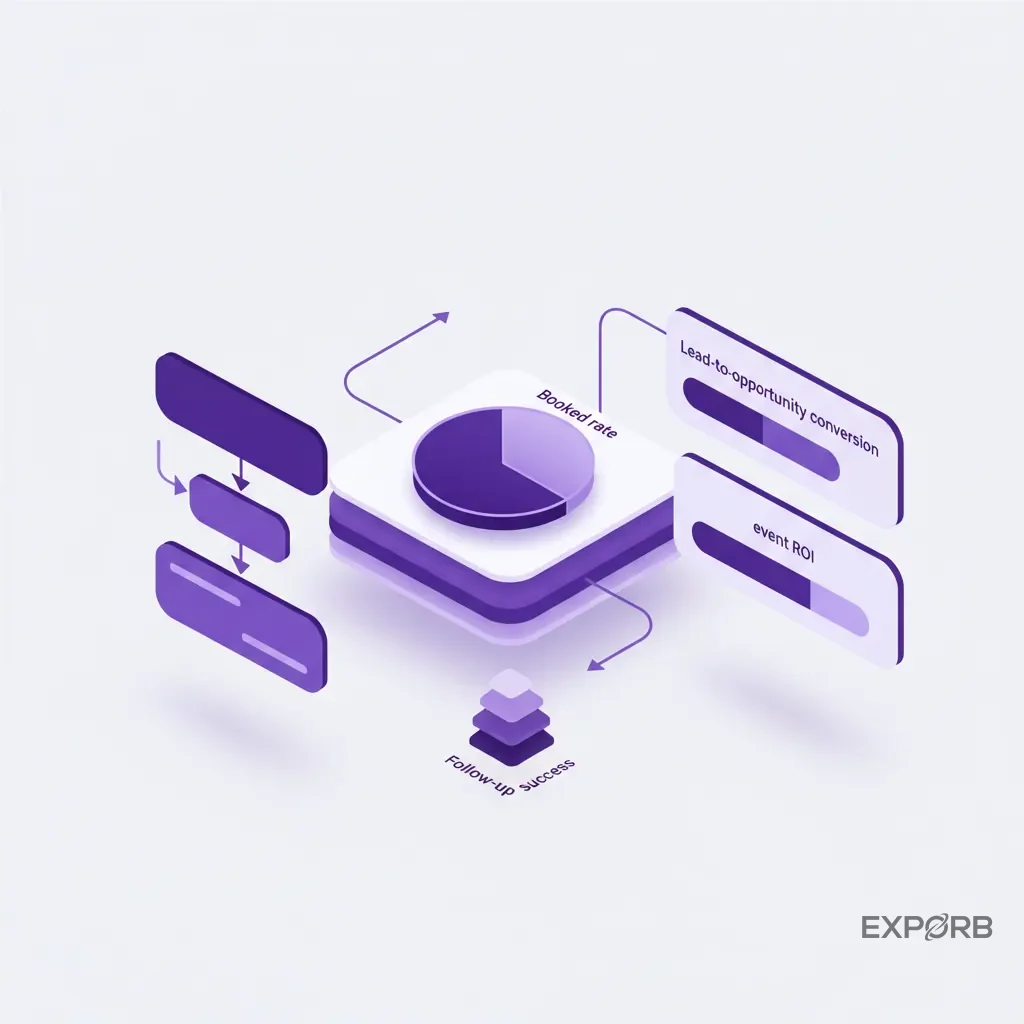
Key metrics for 2026: meeting booked rate, lead-to-opportunity conversion, and event ROI
Stop reporting on the number of badges scanned. The metrics that matter are your meeting booked rate, lead-to-opportunity conversion rate, event-sourced pipeline, and event ROI. The first tells you how effective your emails are. The second measures lead quality. The last two tell you if the whole thing was worth the investment.
Using UTM parameters and dedicated booking links for accurate attribution
To make tracking easier, use simple tools to connect the dots.
- UTM Parameters: Add UTM tags to all links in your follow-up emails (e.g.,
utm_source=tradeshow&utm_campaign=eventname2026). This allows you to see in your web analytics which website visits and conversions came directly from you
r follow-up.
- Dedicated Booking Links: Create a unique calendar booking link for each event. This way, the system automatically attributes any meeting booked through that link to the correct show, with no manual data entry required.
Free PDF Template
Download All 8 Email TemplatesActivate your high-ROI trade show follow-up plan today
You don't need to wait for your next event to start improving. A high-performing follow-up strategy depends on disciplined preparation and the right tools. It's about shifting focus from simply collecting names to systematically capturing context.
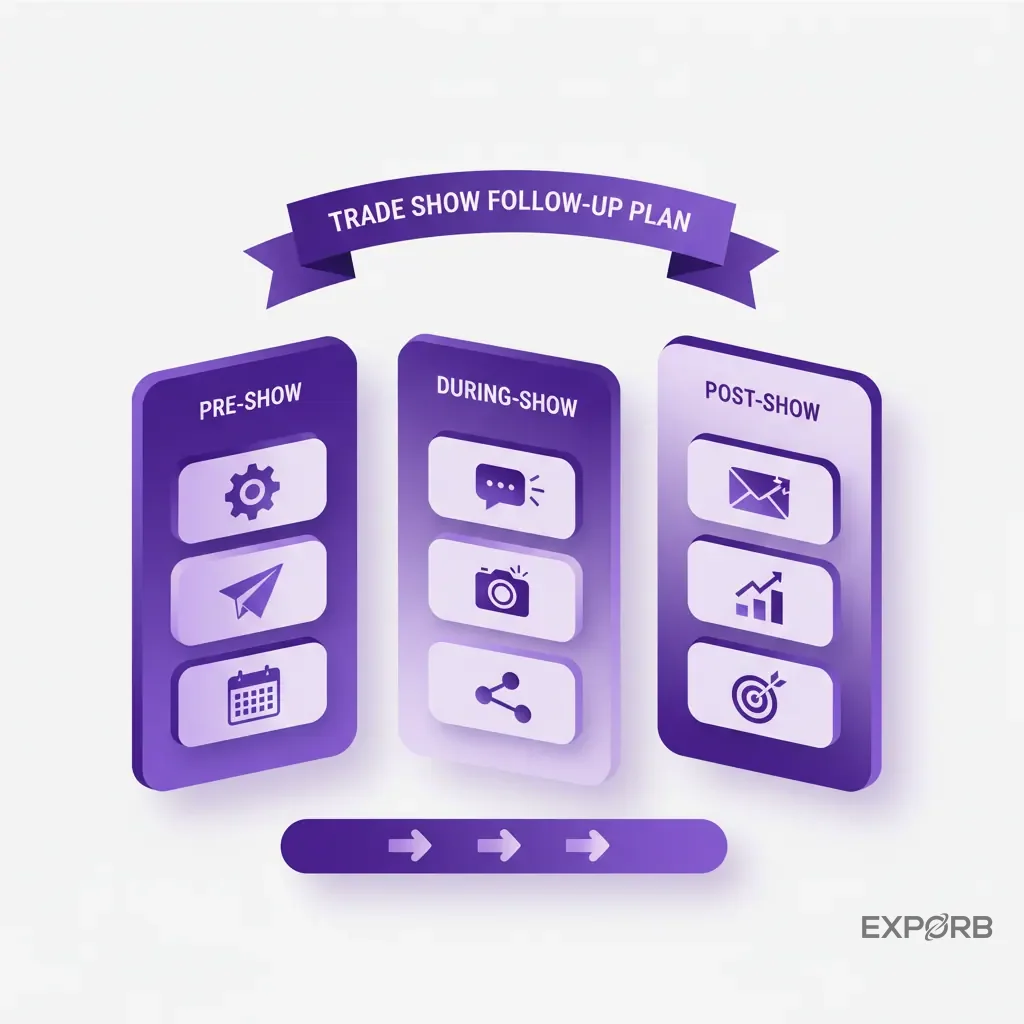
Your step-by-step checklist for pre-show, during-show, and post-show actions
Pre-Show:
- Define your lead segmentation tags (Hot, Warm, Cold).
- Create your lead scoring criteria.
- Build your structured note-taking template.
- Pre-write your follow-up email sequences for each segment.
- Train your booth staff on the data capture process.
During-Show:
- Execute the structured lead capture process for every conversation.
- Score and segment every lead in real-time.
- (Optional) Send "Day 1" follow-ups to hot leads from your hotel room.
Post-Show (Within 24 Hours):
- Export your segmented lead lists.
- Personalize and send your first follow-up email touchpoint.
- Import all leads into your CRM with the correct event tag.
- Launch your multi-touch nurture sequences.
How Exporb automates the hardest parts of trade show follow-up
The biggest bottleneck in this entire process is turning messy booth conversations into clean, structured data you can act on quickly. This is where we come in. We designed our app to be the bridge between your booth staff and your follow-up campaigns.
Your team captures everything on their phone—business cards, voice notes, photos—and our app automatically structures, transcribes, and enriches the data. This eliminates the post-show data entry nightmare and gives you a clean, segmented list, ready for immediate follow-up. You get the speed you need without sacrificing the personalization that drives replies.
Booking more meetings from your next event
Stop leaving money on the table. The leads you meet at trade shows are some of the most valuable you'll ever generate. Treating your follow-up process with the same strategic importance as your booth design is key to turning those conversations into real revenue.
So, the next time you plan an event, will you spend as much time on your data capture plan as you do on your booth graphics? The answer to that question will determine your ROI.
These trade show follow-up email templates do one thing: turn booth conversations into pipeline. Download all 8 as a PDF so you have them ready before your next show.