Why is trade show networking still critical for B2B growth in 2026?
You've heard the talk: "Is the trade show dead?" For years, people have predicted the end of in-person events, yet we're here. The reason's simple: nothing replaces a face-to-face conversation for building trust. These events are concentrated markets where your ideal customers, partners, and competitors are all within walking distance. This guide provides actionable trade show networking tips to turn those handshakes into real pipeline, moving beyond outdated tactics that leave you with a pocketful of useless business cards.
The problem isn't the trade show itself. It's how most companies approach them. They'll spend $50,000 on a stunning booth with flashy lights and free swag but then have a $0 strategy for capturing what actually matters—the conversations happening inside it. That's completely backwards.
Moving beyond handshakes: the shift to data-driven connections
For decades, the goal was collecting as many business cards as possible. You'd return to the office with a stack of them, dump 'em on a desk, and spend the next week trying to decipher your messy handwriting and remember who was who. "John - Acme Corp - interested in Q3." Interested in what? What was his main problem? You'd have no idea.
That approach is dead.
Today, networking is about capturing structured data. The goal is to capture the full context: what people said, why it matters, and what the next step is. Every conversation's a data point. You need to capture that data accurately at the source—the booth—so your follow-up feels personal, relevant, and immediate. You're building a dataset of market intelligence one conversation at a time.
The ROI of in-person events vs. digital channels
Let's be clear: digital marketing is essential. But it's also crowded and noisy. Prospects can delete an email. They'll scroll past a social media ad. But a real conversation? That creates a connection.
According to research from LIVEPLAN, event marketers consistently rank in-person events among the top three most effective channels for driving real business outcomes like Lead Generation. They consistently outperform webinars and virtual events because they create tangible moments. You can read a prospect's body language, hear the hesitation in their voice when they describe a problem, and sketch out a solution on a napkin. A Zoom call can't replicate that level of connection—and qualification. The ROI comes from the quality of those leads and how quickly they move through your pipeline.
Challenging the myth: why quality conversations matter more than a stack of business cards
The old metric for success was the weight of the fishbowl filled with business cards. It was a vanity metric that made everyone feel busy but generated very little revenue. A hundred vague contacts are worth less than five deep conversations with genuine prospects who have a problem you can solve.
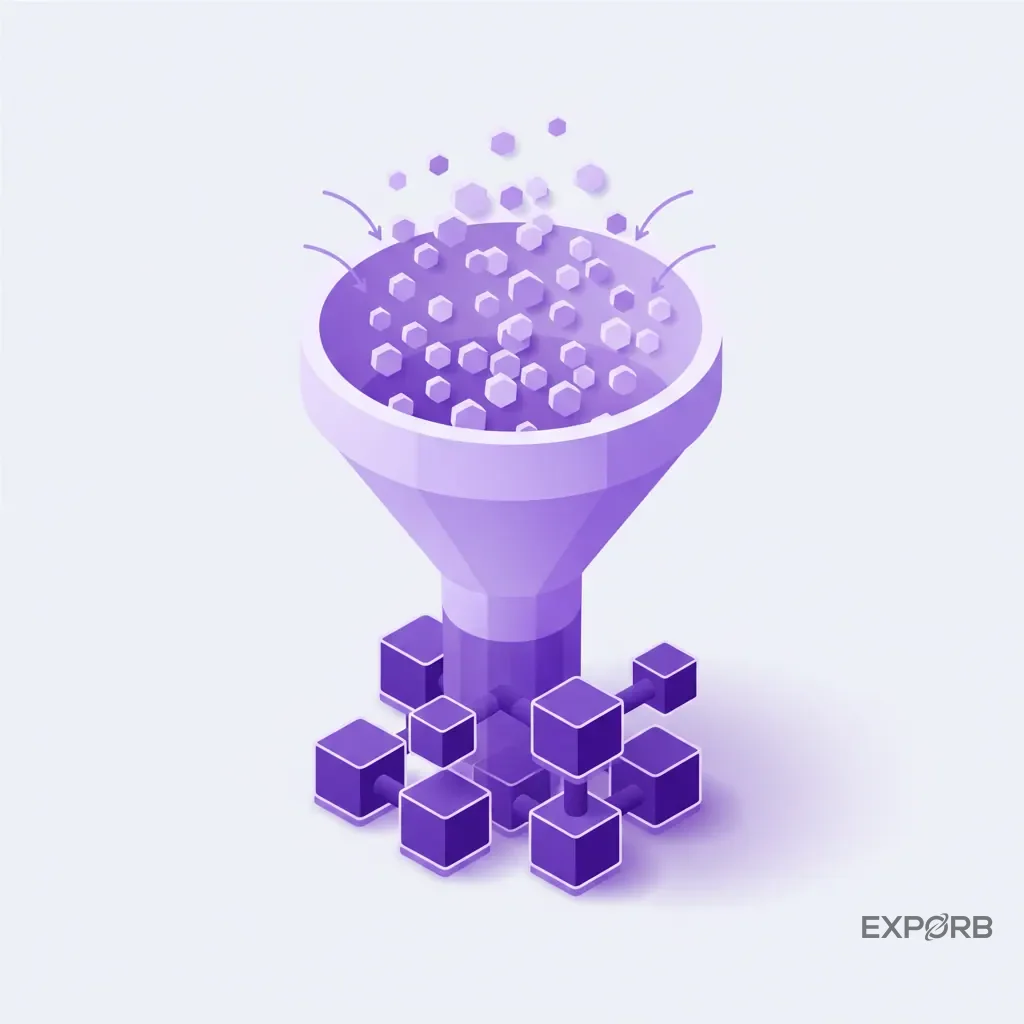
The myth says more is better. The reality? Better is simply better. Your goal isn't talking to everyone. It's having meaningful dialogues with the right people. This requires a complete shift in mindset. Stop thinking like a collector and start thinking like a consultant. Your job on the show floor is to diagnose problems. A scanned badge gives you a name. A real conversation gives you intent, budget, and a timeline. Which one do you think your sales team wants?
How do you build a strategic networking plan before the event?
The most successful exhibitors win the show before they even arrive. They don't just show up hoping for the best. They have a plan. They know who they want to meet, what they want to learn, and how they'll measure success. Walking onto a trade show floor without a plan is like sailing without a map—you'll be busy, but you won't get anywhere.
Your networking starts weeks before you pack your bags, turning a chaotic environment into a series of planned, high-value interactions.
Defining your 'who': setting clear goals and ideal contact profiles (ICPs)
Who, specifically, do you need to meet? "Anyone interested in our product" isn't an answer. That's a recipe for wasting time with tire-kickers and students collecting free pens. You need to get surgically precise.
Start with your Ideal Contact Profile (ICP).
- Job Titles: Are you looking for VPs of Operations, Lead Engineers, or CMOs?
- Company Size: Do you serve startups, mid-market companies, or enterprise giants?
- Industry: Which verticals are your sweet spot?
- Pain Points: What specific problems do your best customers have that you can solve?
Once you have your ICP, set clear, measurable goals. Don't just aim to "get leads." Aim for something specific:
- "Book 15 qualified demos with VPs of Marketing from fintech companies."
- "Identify 5 potential channel partners in the APAC region."
- "Get competitive intelligence on Product X from 10 current users."
These goals give your team purpose. They transform their mission from "scan everyone" to "find these five people."
Using event apps and LinkedIn for pre-show research and outreach
Most trade shows have an official event app with an attendee list. This is your goldmine. Don't wait until the show to start networking. Weeks before, you should be combing through that list, cross-referencing attendees with your ICP on LinkedIn.
According to guidance from LinkedIn, pre-show engagement is a massive advantage. Here's a simple workflow:
- Export the List: If possible, get the attendee list from the event app or organizers.
- Filter for ICPs: Sort the list by company, title, and industry to find your targets.
- Research on LinkedIn: Look up your top 20-30 targets. What have they posted about recently? Did they just get funding? Are they hiring for a role related to your solution?
- Connect & Engage: Send a personalized LinkedIn connection request. Don't pitch. Say something simple: "Hi [Name], I see we're both attending [Event Name] next month. I was impressed by your recent post on [Topic]. It'd be great to connect and maybe say a quick hello at the show. Our booth is [Number]."
This warms up the conversation. When you meet them in person, you're not a stranger; you're that person from LinkedIn. It completely changes the dynamic.
Mapping the floor: identifying key exhibitors, speakers, and networking zones
Get the floor plan as soon as it's released. Your best prospects aren't just walking the aisles; they're speaking at sessions, visiting your competitors, or hanging out in specific zones.
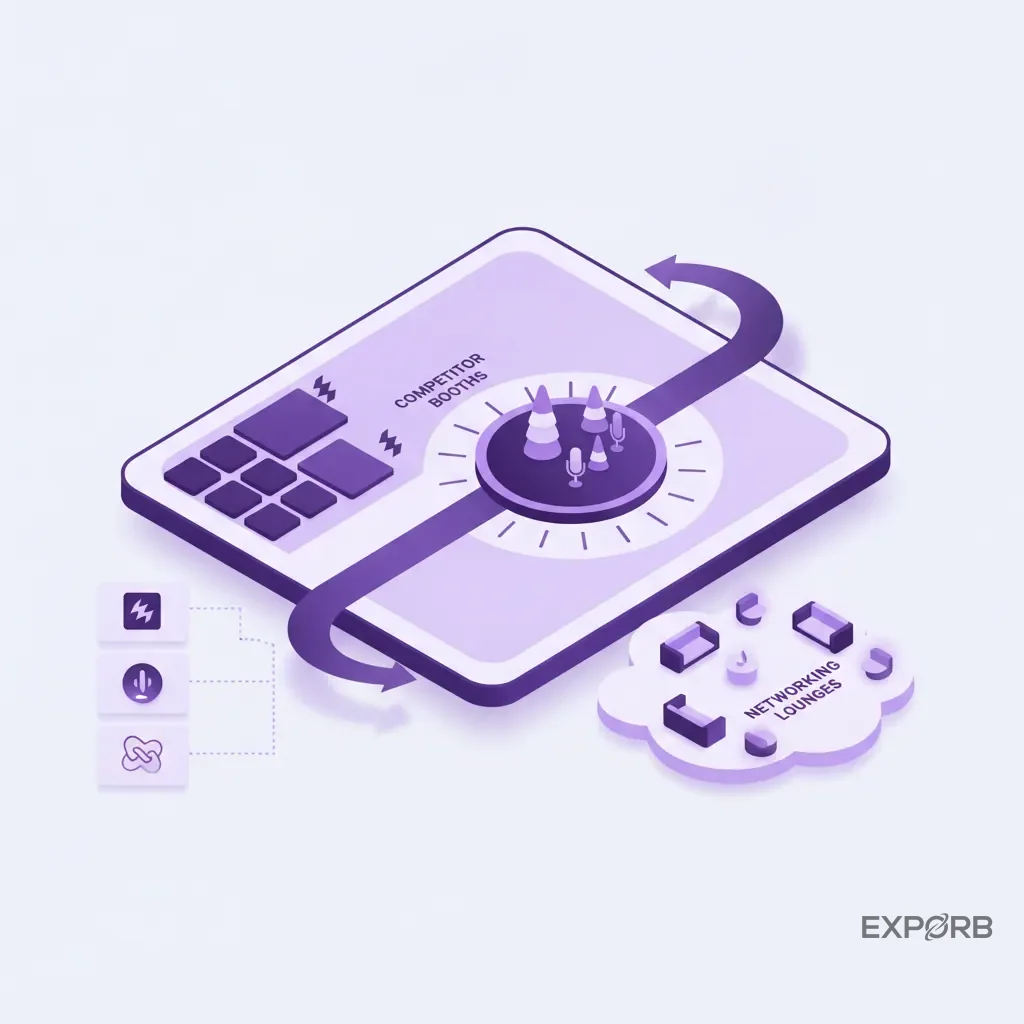
- Competitors: Where are your direct competitors located? It's a great place to observe their messaging and see who they're talking to.
- Partners & Integrations: Where are your complementary partners? Plan to visit them to strengthen relationships and discuss co-marketing opportunities.
- Key Speakers: Who from your target list is speaking? Attend their session. It gives you the perfect, non-salesy reason to approach them afterward: "Great talk on [Topic]. I had a question about your point on..."
- Networking Lounges & Cafes: These are often less chaotic than the main floor. Mark them on your map as places to take important conversations or to simply observe who is meeting whom.
Your map becomes your battle plan. You aren't wandering aimlessly. You're moving with intent from one strategic point to the next, ready to engage.
Related: [The Complete Trade Show lead capture Guide](/blog/trade-show-lead-capture-guide)
What are the most effective networking strategies on the trade show floor?
You've done your prep work. You have your list of targets and your map. Now it's game time. The trade show floor is loud, crowded, and overwhelming. Without the right techniques, you'll blend into the noise. Effective networking on-site is a mix of art and science—having a human conversation while systematically qualifying the opportunity.
The goal is to ask the right questions and listen—really listen—to the answers.
The first 30 seconds: crafting compelling conversation starters that aren't sales pitches
"Can I scan your badge?" is the worst opening line in trade show history. It's transactional, lazy, and immediately puts people on the defensive. You need to open with curiosity, not a request.
Your opener should be about them.
- Observational: "I see you're with [Company Name]. I'm a big fan of how you handle [Specific Thing]. What brings you to the show this year?"
- Problem-Oriented: "A lot of people I've talked to today are struggling with [Common Problem]. Is that something on your radar?"
- Session-Related: "I saw you were in the AI keynote this morning. What did you find most interesting?"
Notice a pattern? They're all open-ended questions. They invite a story. Your first goal is getting them talking. The pitch can wait.
Active listening techniques that uncover true pain points and buying intent
Once they're talking, your most important job is to shut up and listen. As American Image Displays points out, the best networkers spend up to 70% of the conversation listening. Don't just wait for your turn to talk. Listen to understand.
- Ask "Why?" Five Times: When they mention a problem, don't jump to the solution. Dig deeper. "Our reporting is slow." -> "Why's that an issue?" -> "Because my team wastes a day pulling numbers." -> "Why's that day so important?" -> "Because we're missing our window to act on the data." Now you've gone from a technical issue to a real business pain.
- Parrot and Peel: Repeat the last few words of their sentence as a question. "We're having trouble with data silos." -> "Data silos?" This encourages them to elaborate without you having to lead the conversation.
- Listen for Keywords: Pay attention to words like "frustrating," "bottleneck," "manual," "wish we could," or "struggling with." These are buying signals. When you hear one, that's your cue to ask a follow-up question about that specific pain.
It's a diagnostic process. You're a doctor trying to understand the symptoms before you prescribe the medicine.
Graceful exits: how to politely end a conversation and move to your next target
Equally important as starting a conversation is knowing how to end one. You can't spend 45 minutes with a non-prospect while your ideal customer walks by. You need a polite, professional way to disengage.
Here are a few proven exit lines:
- The Positive Hand-off: "This has been a fantastic conversation. I know you've got a lot of ground to cover, and so do I. I've got your details, and I'll send over that case study we talked about. It was great meeting you, [Name]."
- The Next-Step Close: "Based on what you've said about [Problem], I think it makes sense for you to chat with our technical expert, [Colleague's Name]. Let me grab your card, and I'll set up a brief call for next week. I don't want to take up any more of your time on the floor."
- The Honest Approach (for non-fits): "I really appreciate you sharing that. It sounds like what we do might not be the right fit for your current needs, and I want to be respectful of your time. It was great learning about [Their Company] though. Enjoy the rest of the show!"
The key is controlling the conversation's lifecycle. Open with purpose, listen intently, and close with a clear next step (or a clear "no"). This respects both your time and theirs.
Which tech tools are essential for modern trade show lead capture?
The days of a pen, a clipboard, and a fishbowl for business cards are over. If that's still your "tech stack," you're losing leads, context, and revenue. Modern networking is powered by tools that make lead capture faster, richer, and more reliable—especially in the chaos of a busy exhibit hall where Wi-Fi is notoriously bad.
Your phone is now your most powerful networking tool. You need specialized software that turns a fleeting conversation into a structured, actionable asset for your entire company.
From business cards to AI OCR: capturing contact data without manual entry
The business card is still a staple of trade shows, but manual data entry is a soul-crushing bottleneck. Your team comes back with hundreds of cards, and someone has to spend days typing them into a spreadsheet or CRM. Typos are inevitable, and context is lost.
This is a solved problem.
Modern lead capture apps use AI-powered Optical Character Recognition (OCR). You just snap a photo of a business card, and the AI instantly pulls the name, title, company, email, and phone number into the correct fields. It's faster and more accurate, working in any language. The days of deciphering fancy fonts and returning to the office with a data entry project are finished. You capture the data perfectly in seconds, right at the booth.
Using QR codes and digital forms for compliant, instant information exchange
What if someone doesn't have a business card? Or what if you need more than just their contact info? This is where QR codes and digital forms shine. You can have a QR code at your booth that links directly to a simple form.
This approach has two big advantages:
- More Data: You can ask qualifying questions directly in the form. "What's your biggest challenge with X?" or "What's your timeline for a new solution?" This gives you structured data that's easy to segment later.
- Compliance: With privacy laws like GDPR, you must get consent. Having someone fill out a form with a clear opt-in checkbox is a bulletproof way to document their consent to be contacted. It's much cleaner than the implied consent of dropping a business card in a bowl.
The power of conversation intelligence: how offline audio transcription ensures no detail is lost
Here's the biggest black hole in trade show ROI: you forget what you talked about. You'll remember the person's name (thanks to the card scanner), but the critical details of the conversation—the specific pain points, the budget numbers they mentioned, the name of the internal champion—they fade.
This is where recording conversations becomes a necessity. Think of it as digital note-taking. You can't possibly type fast enough to capture the nuance of a 10-minute conversation.
We built Exporb so you can record voice notes attached to a lead's profile. The capture works completely offline, so it doesn't matter if the convention center Wi-Fi dies. As soon as you're back online, the audio is automatically transcribed and analyzed by AI. Now you have a searchable, permanent record of the entire conversation. You can find every lead who mentioned "integration" or "Q4 budget." This context makes the difference between a generic follow-up email and one that closes the deal.
How can you ensure your entire team networks effectively and consistently?
A trade show is a team sport. But too often, it's played by a group of individuals doing their own thing. One rep's a rockstar, taking careful notes. Another's just scanning badges. A third's having great chats but capturing nothing. The result is a messy, inconsistent pile of leads that are impossible to follow up on effectively.
As a founder or manager, you're flying blind. You've no idea what your team is learning or who they're meeting. Centralizing your team's networking strategy is essential for maximizing ROI.
The founder's dilemma: solving the lack of visibility into team conversations at events
You send five people to a show. They meet 200 prospects. You ask them how it went, and you get a vague, "It was great! Lots of good conversations."
Which ones were good? Why were they good? Who needs a follow-up today versus next quarter? You have no visibility. The intelligence your team gathered is trapped in their heads or on the back of random business cards.
At Exporb, we built our platform to solve this. A shared platform for team collaboration gives you a real-time dashboard of every conversation. You can see who talked to whom, what was discussed (thanks to transcriptions), and how each lead was qualified. It turns the "black box" of a trade show into a transparent, data-rich operation. You see the event's value unfold lead by lead, with clear insights into performance.
Training your team on a unified message and Lead Qualification criteria
Consistency starts with a shared playbook. Before the event, you need to align the entire team on a few key things:
- The 30-Second Pitch: Everyone should explain what your company does and who it's for in a clear, concise way. It should sound natural. Role-play this before you go.
- Lead Qualification (BANT): What makes a lead "hot," "warm," or "cold"? Define it with specific criteria. A common framework is BANT:
- Budget: Do they have the funds allocated?
- Authority: Are they a decision-maker or an influencer?
- Need: Is the pain point they described something you can solve?
- Timeline: Are they looking to buy this quarter or next year?
- Key Questions: Give your team a short list of 3-5 open-ended questions to ask every prospect. This means you're capturing the same core data points from everyone.
This training ensures that a lead captured by Jane is qualified the same way as a lead captured by John, making your post-show segmentation much more reliable.
Dividing and conquering: assigning roles, territories, and goals for each team member
Don't just throw your team onto the floor. Assign specific roles and responsibilities to maximize coverage and efficiency.
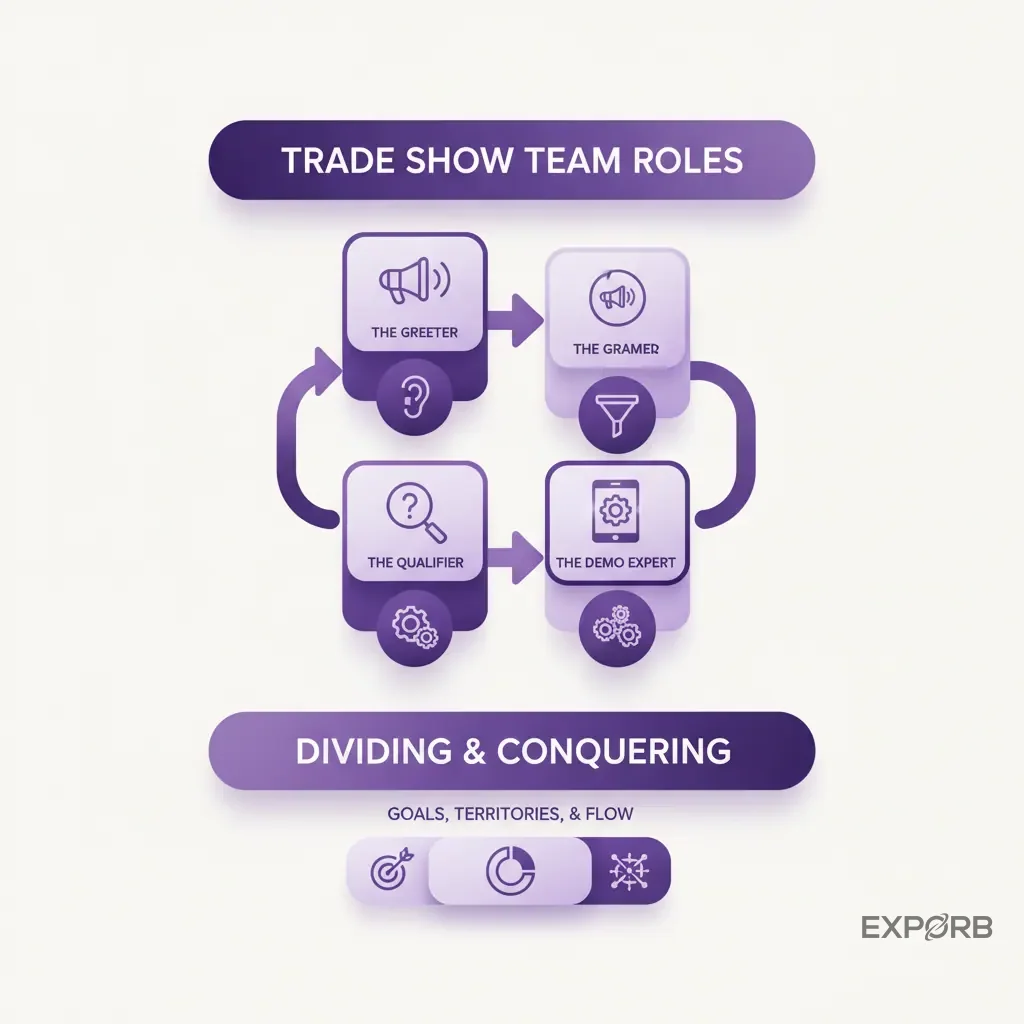
- The Greeter: Someone friendly and high-energy at the front of the booth to engage people walking by and make the initial connection.
- The Qualifier: Their job is having the 2-3 minute BANT conversation to see if there's a real opportunity. They separate the suspects from the prospects.
- The Demo Expert: Once a lead is qualified, they get handed off to the demo expert for a deeper product exploration. This person should be your most technical team member.
- The Roamer: This person doesn't stay at the booth. Their job is executing the pre-show plan—attending sessions, meeting with targets, and gathering competitive intelligence.
By assigning roles, you create a well-oiled machine. Everyone knows their job, handoffs are smooth, and you're using your team's diverse skills to their full potential, which boosts your overall performance.
What are the unique networking benefits for small businesses at trade shows?
Big companies have massive booths, huge budgets, and armies of staff. As a small business, you can't compete on those terms. And you shouldn't try. Your advantages are different. You have agility, authenticity, and the ability to build genuine relationships that larger, more corporate companies can't.
A trade show can be a great equalizer. It puts you in the same room as the industry giants. With the right strategy, you can walk away with better relationships and a stronger pipeline than competitors ten times your size.
Building brand authority and trust on a bootstrapped budget
You don't need a 50x50 foot island booth to build authority. You build it one conversation at a time. When a prospect talks to someone from a big company, they're often talking to a junior sales rep who's just there to scan badges. When they talk to you, they might be talking to the CEO, the head of product, or the lead engineer.
That's a massive advantage.
You can answer their deepest technical questions. You can tell them the founding story of the company. You can make a commitment on the spot. This level of access builds incredible trust. Prospects feel like they're talking to a partner. Your authority comes from your expertise.
Forging strategic partnerships with non-competitors and channel players
Trade shows are also one of the best places to find partners. Walk the floor and look for companies that serve the same customer base as you but don't compete with your product.
- Integration Partners: Find tech companies whose products would be more valuable if integrated with yours.
- Channel Partners: Look for resellers, distributors, or agencies who could sell your product to their existing client base.
- Co-Marketing Partners: Identify companies with a similar audience for potential webinars, content swaps, or joint events.
- Media Partners: Find industry bloggers or publications to build relationships with for future coverage.
Go to their booth. Introduce yourself. Schedule a coffee. A single good partnership can be more valuable than a hundred leads. As a small business, you can be more flexible and creative with partnership terms, which is often attractive to other companies.
Using agility for faster, more personal follow-up that bigger companies can't match
This is your secret weapon. While the big guys are waiting a week for their marketing department to approve a generic email blast, you can be personal and immediate.
The faster you follow up, the higher your conversion rate. According to industry best practices highlighted by sources like American Image Displays, the 24-48 hour window is critical. But what if you could follow up in 24 minutes?
With modern tools, the person who had the conversation at the booth can trigger a follow-up email before the prospect has even left the building. Using a tool with AI-powered email follow-up, you can use the context from the conversation—the specific pain points they mentioned, the next steps you agreed on—to draft a highly personalized message instantly. You just review it and hit send from your phone.
This speed and personalization is something big, bureaucratic companies can't easily replicate. It shows the prospect they were heard and that you're responsive. It's how small businesses cut through the noise and close deals faster.
Related: How to Write Trade Show Follow-Up Emails That Get Replies
The art and science of post-show follow-up that actually converts
You had a great show. You talked to dozens of qualified prospects. You're flying home feeling optimistic. But the most important part of the trade show happens after the trade show. All that effort is wasted if your follow-up is slow, generic, and disorganized.
Most trade show leads die from neglect. A study by Sales Layer found that a shocking number of exhibitors fail to follow up on their leads at all. This is where you can gain a massive competitive edge. Effective follow-up must be a system.
The 24-48 hour rule: why speed and context are your most valuable assets
The clock starts ticking the moment a prospect leaves your booth. Their memory of your conversation is fading fast. They're also being bombarded with follow-up emails from every other exhibitor they spoke with. Your message needs to arrive while the conversation is still fresh in their mind.
Speed is your first advantage. As mentioned, following up within 24-48 hours is the industry standard for a reason. Waiting a week is a death sentence. By then, their enthusiasm has cooled, and they've forgotten the details of your solution.
Context is your second—and more powerful—advantage. A generic email that starts with "Nice to meet you at [Event Name]" is destined for the trash folder. It shows you don't remember them. A powerful follow-up email references the specifics of your conversation.
- Bad: "Thanks for stopping by our booth."
- Good: "Following up on our chat about the trouble you're having with manual data entry for your logistics team..."
The second one proves you were listening. It immediately re-establishes the connection and shows you understand their problem. This is only possible if you captured detailed notes or a conversation recording at the booth.
Segmenting your leads (hot, warm, cold) for personalized outreach sequences
Not all leads are created equal. Blasting the same email to everyone you met is lazy and ineffective. Before you send a single message, you need to segment your list based on the qualification criteria you used at the booth.
A simple lead segmentation framework for trade show follow-up.
This segmentation allows you to focus your sales team's time on the leads most likely to close, while still nurturing future opportunities with automated sequences.
Structuring follow-up data in your CRM for long-term nurturing and sales alignment
The goal of lead capture goes beyond sending one email. It's about creating a rich, detailed record in your CRM that will inform your sales and marketing efforts for months or even years to come.
When you export your leads, don't just send over a name and email. Make sure you're including all the rich context you gathered.
- Lead Source:
Trade Show: [Event Name 2026] - Notes: A summary of the conversation or the full transcription.
- Pain Points: Use tags like
manual_reporting,data_silos,integration_issues. - Lead Temperature:
Hot,Warm, orCold. - Next Step:
Book Demo,Send Case Study,Follow up in Q3.
Getting this structured data into your CRM is critical. It enables your sales team to have informed conversations and allows your marketing team to create targeted campaigns based on real, self-reported pain points. A clean export to your CRM is the final, important step in turning a booth conversation into a closed deal.
Advanced networking tips for seasoned professionals and exhibitors
You've mastered the basics. You have a pre-show plan, your team is trained, and your follow-up is a well-oiled machine. So, what's next? How do you go from being a good exhibitor to being one of the most talked-about companies at the show?
It's about creating unique experiences and engaging in conversations beyond the four walls of your booth. Advanced networking means building a community.
Hosting micro-events or private dinners to deepen high-value relationships
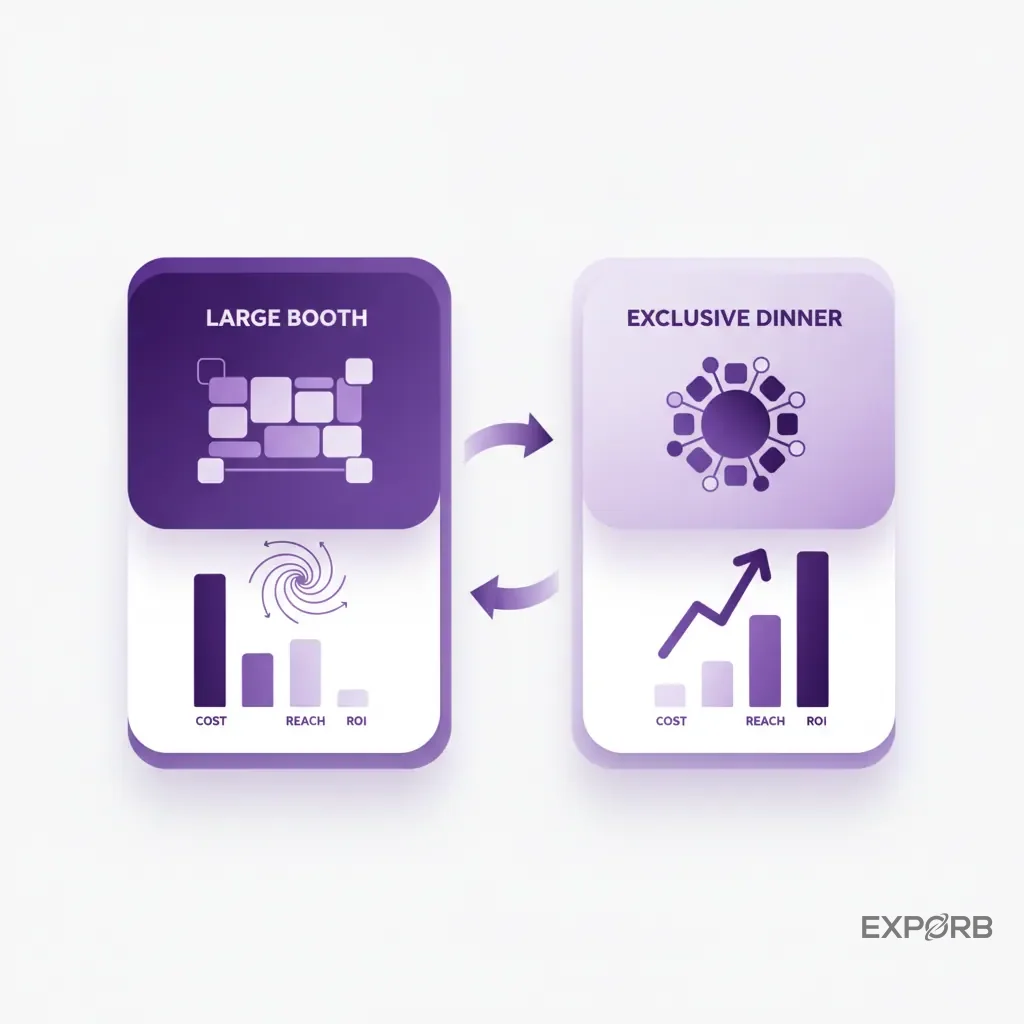
The trade show floor is great for initial connections, but it's a terrible place for a deep, strategic conversation. It's too loud and there are too many distractions. For your top 5-10 prospects or key partners, take the conversation off-site.
Hosting a small, curated event is a powerful way to stand out.
- Private Dinner: Rent a private room at a nearby restaurant and invite a dozen of your most important contacts. The focus is on building relationships. Have a theme for the discussion, but keep it informal.
- Whiskey/Wine Tasting: A more relaxed and memorable experience than another generic happy hour.
- Morning Coffee & Strategy Session: For the early risers, host a breakfast roundtable before the show floor opens. Discuss a key industry trend and encourage conversation among your guests.
These micro-events show that you value these relationships beyond a simple lead scan. They create a shared experience and give you hours of quality time with people who can significantly impact your business.
Using social media and event hashtags in real-time to join wider conversations
The conversation about the event also happens online. Tapping into this digital backchannel can amplify your reach and help you connect with people you might otherwise miss.
- Monitor the Hashtag: Every event has an official hashtag (e.g., #SaaStr2026). Use a tool like TweetDeck or Hootsuite to monitor it in real-time.
- Add Value, Don't Spam: Don't just tweet "Come visit us at booth #123." Instead, share valuable insights. Post something important you learned from a session you attended. Ask a thought-provoking question related to the event's theme.
- Engage with Speakers and Influencers: If a speaker says something interesting, quote-tweet them with your own thoughts. It's a great way to get on their radar.
- Use LinkedIn and X for Meetups: See someone you want to meet tweeting about the event? Reply publicly or send a DM: "Great point! I'm also here at the show. I'd love to connect for 5 minutes if you have a gap."
This shows you're an active participant in the industry, not just a passive exhibitor.
Exploring industry-specific pavilions and hosted buyer programs for curated connections
Many large trade shows have smaller, more focused "pavilions" or "zones" dedicated to specific industries or technologies (e.g., the "AI in Healthcare Pavilion"). These are hotspots for high-quality, pre-qualified prospects. Make sure you identify these on your floor map and dedicate time to networking there.
Even better are "hosted buyer" programs. These are formal matchmaking services run by the event organizers. They connect vendors with high-level executives who have confirmed budgets and are actively looking for solutions. These programs often require an application and an additional fee, but the ROI can be immense. You get a guaranteed series of meetings with people who are paid to be there to find products like yours. You're put directly in front of buyers with real purchasing intent.
How do you measure networking ROI beyond just counting leads?
If your only metric for trade show success is the number of badges you scanned, you're missing the point. That's a vanity metric. A simple lead count shows busyness, not productivity. To truly understand the value of your event budget, you need to track metrics that connect directly to revenue.
Measuring ROI means proving that the time, money, and effort you invested in the show generated a tangible return for the business. It's how you justify next year's budget and make your event strategy smarter over time.
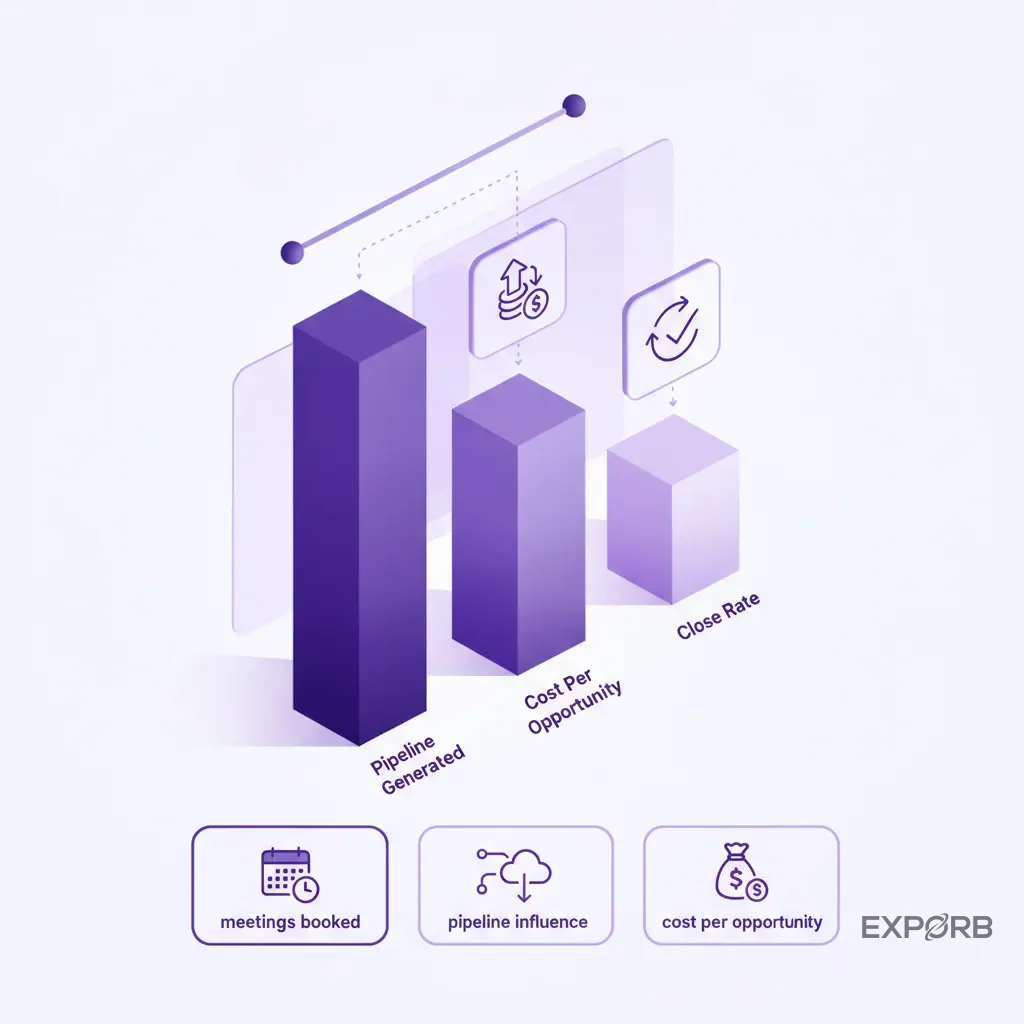
Key metrics for 2026: meetings booked, pipeline influence, and cost per opportunity
The number of leads is just the starting point. Here are the metrics that actually matter:
- Lead-to-Meeting Rate: What percentage of the leads you captured converted into a scheduled meeting or demo? This is the first and most important conversion point.
- Pipeline Generated: Of those meetings, how much potential revenue did you add to your sales pipeline? You'll need to work with your sales team to assign a dollar value to each opportunity.
- Cost Per Opportunity: This is a critical one. Divide your total event cost (sponsorship, travel, salaries, etc.) by the number of qualified opportunities generated. This tells you how efficient the event was at creating pipeline compared to other channels like Google Ads or content marketing.
- Pipeline Influence: Sometimes a trade show conversation doesn't create a new opportunity but accelerates an existing one. Tag deals in your CRM that were "touched" or "influenced" by the event.
- Close Rate: What percentage of the opportunities generated from the event ultimately became closed-won deals? This is the ultimate measure of lead quality.
Tracking these metrics requires tight alignment between your marketing and sales teams and disciplined use of your CRM.
Conducting a post-mortem: analyzing what worked, what didn't, and why
Within a week of returning from the show, gather everyone who attended for a post-mortem meeting. You need an honest assessment of the event while the details are still fresh.
Discuss these questions:
- Goals vs. Reality: Did we achieve the specific goals we set before the show? If not, why?
- Lead Quality: What was the overall quality of the booth traffic? Did we talk to the right people (our ICPs)?
- Messaging: Did our pitch resonate with people? What questions did we get asked most often?
- Booth & Location: Was our booth location good? Was the layout effective at drawing people in?
- Team Performance: Who were our top performers? What can we learn from them? Where do we need more training?
- Logistics: What went smoothly? What was a pain (travel, setup, technology)?
Document the answers. This document becomes the foundation of your strategy for the next event. It ensures you don't make the same mistakes twice.
Using event data to forecast and justify your future trade show budget
When it's time to ask for next year's budget, you can't just say, "The show felt really good." You need to come armed with data.
Using the metrics you've tracked, you can build a powerful business case.
- "We spent $40,000 on this event."
- "We generated 50 qualified opportunities."
- "That's a Cost Per Opportunity of $800."
- "Our average deal size from the event was $15,000, and our close rate was 20%."
- "This means for every $40,000 we invest, we generate $150,000 in new revenue."
That's a conversation that gets a CFO's attention. This data-driven approach transforms the Event marketing budget from an "expense" into a predictable, revenue-generating "investment." It's how you prove your value and secure the resources you need to grow.
Your trade show networking playbook for immediate implementation
You've learned the strategies and the tactics. Now it's time to put them into action. A successful trade show is all about disciplined execution. This playbook is your final checklist for preparation, on-site efficiency, and effective follow-up, so don't just read it—use it.
Your pre-show checklist: the 7-day countdown to success
One week before the show, your team should be in the final stages of preparation.
- [ ] 7 Days Out: Finalize your list of target contacts. Send out the last round of pre-show meeting requests via LinkedIn and email.
- [ ] 6 Days Out: Hold the final team training session. Role-play conversation starters, the qualification process, and graceful exits. Confirm everyone understands their assigned roles.
- [ ] 5 Days Out: Pack your on-site essentials kit (see below). Charge all devices.
- [ ] 4 Days Out: Download the event app. Review the final session schedule and floor plan. Add key sessions and meetings to your calendar.
- [ ] 3 Days Out: Travel day. Use the flight time to do a final review of your top 10 target profiles.
- [ ] 2 Days Out: Arrive and get settled. Walk the convention center to get your bearings.
- [ ] 1 Day Out: Team huddle. Review the plan for the first day. Set daily goals for conversations and qualified leads. Get a good night's sleep.
The on-site essentials kit (digital tools and physical items)
Being prepared means having the right tools on hand so you can focus on conversations, not logistics.
Digital Kit:
- [ ] Lead Capture App: Your primary tool for capturing and qualifying leads. Make sure it's downloaded on every team member's phone and that they're logged in. Exporb's offline mode is a lifesaver here.
- [ ] Calendar App: For booking meetings on the spot.
- [ ] LinkedIn App: For looking up people in real-time.
- [ ] Event App: For the schedule, map, and attendee list.
Physical Kit:
- [ ] Portable Power Banks: Your phone is your lifeline. Don't let it die. Bring at least two fully charged power banks.
- [ ] Comfortable Shoes: You'll be on your feet for 10 hours a day. This isn't a fashion show.
- [ ] Breath Mints: A simple but important detail.
- [ ] Water Bottle: Stay hydrated. Convention center air is notoriously dry.
- [ ] Small Notebook & Pen: For backup, or for sketching out an idea for a prospect.
Turning your next trade show into your best sales quarter
The trade show doesn't end when you pack up the booth. The momentum you build on-site needs to be carried directly into your sales process.
- Sync Your Data Immediately: The evening the show ends, sync all the data your team captured. Don't wait until you're back in the office.
- Segment and Assign: The next morning, segment your leads into Hot, Warm, and Cold buckets. Assign all Hot leads to their respective sales reps with a clear directive to follow up within 24 hours.
- Launch Your Sequences: Activate the pre-written email nurture sequences for your Warm leads.
- Hold the Post-Mortem: Schedule it for 3-4 days after the show, while everything is still fresh.
- Track Everything: Monitor your CRM dashboard daily for the next few weeks. Track how many meetings are booked, how many opportunities are created, and how the pipeline is growing.
A trade show is a massive injection of opportunity. Follow this playbook, and you won't just come home with a pocket full of business cards—you'll come home with a pipeline full of deals.